

VISIT TWO FASCINATING TOWNS ON A DAY TRIP FROM TANGIER
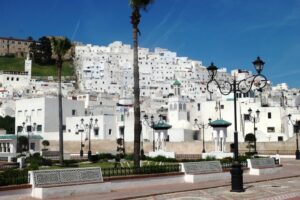
We visited the World Heritage town of Tetouan and the blue town of Chefchaouen on a day trip from Tangier. The delightful people running our little Riad suggested that a car and driver was the most efficient and cost effective way to see these towns, given that Tetouan is over an hour by local bus and Chefchaouen was more than 2 hours by bus. Both towns are always mentioned as Must Sees in that part of the country, and as we discovered, well worth visiting.
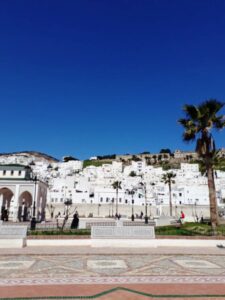
Known as the “White Dove,” Tetouan is renowned as one of the most complete Andalusian-influenced medinas in Morocco, reflecting both the Muslim and Jewish heritage of those who fled Spain centuries ago. It lies about 60 kms east of Tangier on the Mediterranean coast, a few kms south of the Strait of Gibraltar. Its historic, UNESCO-listed medina is famous for its Andalusian architecture and distinct character, and its multicultural identity offers a journey through time.
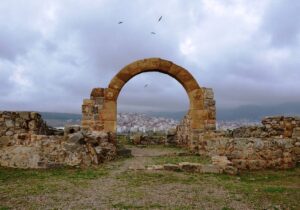
The history of Tetouan goes back more than 2,000 years, and its first settlements belonged to the ancient Mauretanians, a confederation of Berber tribes, dating back to the 3rd century BCE. About 100 years later, the Phoenicians established a trading port there, and eventually it became a Roman colony under the Emperor Augustus.
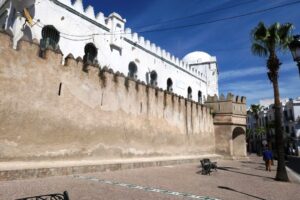
In the late 13th century the Marinids, a Berber dynasty, built a Kasbah and mosque in what is now the old city, and soon after, sultan Abu Thabit Amir fortified the place. However, around the beginning of the 15th century, the Castilians destroyed the settlement in retaliation for raids by pirates who used Tetouan as a base.
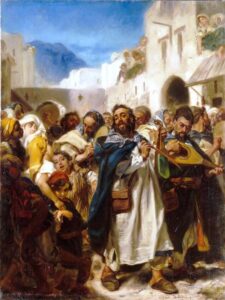
The modern history of the city starts around the 15th century, when it was rebuilt and fortified by Ali al-Mandri, who came from the Nasrid city of Granada, just before the Catholic monarchs, Ferdinand II of Aragon and Isabella I of Castile conquered it. Thousands of Muslims and Jews from Andalusia fled from there and settled in northern Morocco. The city became quite prosperous, and became a major centre for Andalusian art, architecture and trade.
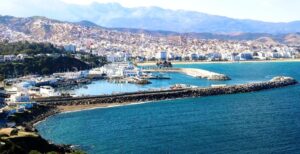
Piracy spread and Tetouan became its main centre. Corsairs considered it a form of revenge against the Spanish for having forced them from their lands back in Andalusia. Their numbers were reinforced by an influx of Muslims who had been forcibly converted to Christianity in Spain. More collaborators joined them, including English and Dutch renegades who were mostly Protestants, although a few had converted to Islam.
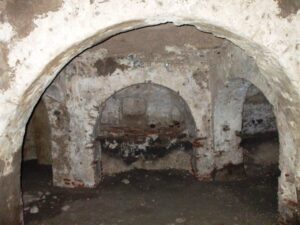
As well as booty, pirates took captives for ransom, holdng them in dungeons in underground prison complexes that were connected by a series of excavated caves. These captives were faced with being sold in the slave market if ransoms were not paid. These subterranean complexes were rediscovered in 1922, along with a 90 sq. m. chapel and altars. The chapel was used by Spanish Franciscans, Portuguese Jesuits and relatives of the captives who made frequent visits to negotiate the Christian captives’ freedom. Unfortunately, due to the considerable risk of damage to the housing above the site, no excavation has yet taken place.
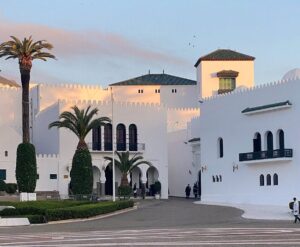
The Alaouites took control of Tetouan in the 17th century, bringing in a period of stability. They built many of the city’s landmarks such as the Maheshwar Palace—also referred to as the Khalifa Palace—and the Pasha mosque.
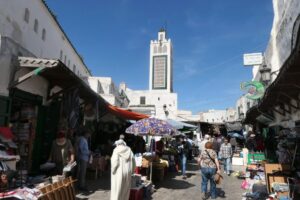
The political history of Tetouan has consisted of an almost continuous tussle between Portugal, Spain, an occasional influx of Jewish refugees from Spain, Algerians fleeing the French invasion of Algiers, and a rising tide of Moroccans from various tribal backgrounds.
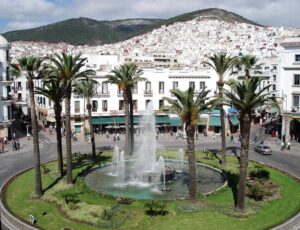
In 1913 Tetouan became the capital of the Spanish protectorate of Morocco, governed by a Khalifa and the Spanish “Alto Comsario”, and remained its capital until 1956. Given its history of being fought over by so many foreign invaders, it’s no surprise that the city was one of the most active Moroccan cities in resisting colonialism. The last Spanish administration built several new neighbourhoods outside the old walled medina, and it acquired an image very similar to other Spanish cities of the time, such as the large, circular Plaza Moulay el Mehdi (formerly Plaza Primo de Rivera), groves planted with orange trees, marble fountains and the distinctly Spanish architectural style of large houses and villas.
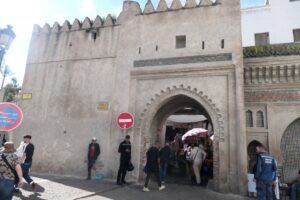
Tetouan’s large medina has seven entrance gates and contains several mosques as well as the Museum of Moroccan Art, which has an excellent collection of regional costumes and typical Moroccan instruments.
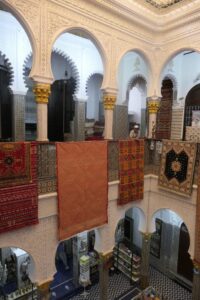
There are many artisan workshops such as rug and textile weavers, jewellery-makers, furriers, ceramicists and the last few tanneries. There were once over 120 tanners in Tetouan, and this thousand-year-old tradition is on the brink of disapearing, in contrast to Marrakesh and Fes, where the secrets and techniques of this craft are still passed down from one generation to the next.
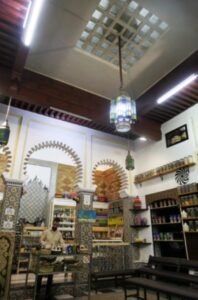
Near the tanners’ quarter is the Tetouan food market, which is a vibrant shopping area that reflects the daily life of the town. Spread over several levels, visitors can explore a variety of shops offering everything from groceries and other necessities, rich displays of fruit and vegetables, to a quirky flower shop with eye-catching bouquets, and handmade rugs on an upper level.
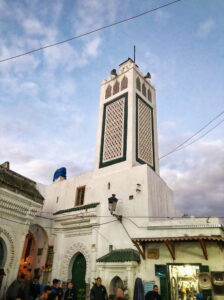
The Kasbah is an integral part of the medina of Tetouan. It’s an historic fortress built in the 14th century by the Marinids, and was an essential defensive structure and administrative centre. Architecturally, it combines Andalusian and Moroccan elements, with narrow streets and whitewashed buildings evoking Hispano-Moorish influences. In addition to its historical and cultural value, the Kasbah has been a source of artistic inspiration. One such artist of international fame was the Spanish painter Mariano Fortuny y Marsal, who captured scenes of life in the Kasbah.
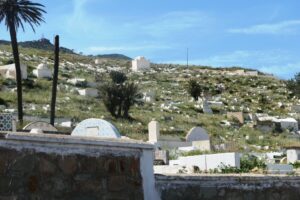
One of the most important areas to explore in Tetouan are the cemeteries. The Jewish Cemetery is one of the largest in Morocco, with more than 20,000 graves, many dating back to the 15th century. The Spanish Cemetery is composed of two sections: the military and the civilian, located opposite each other. The military cemetery houses the graves of Spanish soldiers who died during the period of the Spanish Protectorate in Morocco. These cemeteries are tangible testimonies to Tetouan’s rich and complex history.
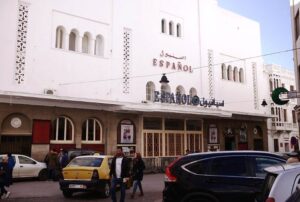
One of the most emblematic buildings in Tetouan is the Spanish Cinema (Cinéma Teatro Español), that is still used for cinema, music and theatre performances. Also make sure to see the Royal Palace of Tetouan, located in Hassan II Square, also traditionally known as Feddan Square. Built around 1740 it has served numerous official functions, and following Morocco’s independence in 1956, the complex was adapted as a Royal Palace. Although not open to the public, it is a significant presence in the town. Further along from the Square is the El Feddan Park, a public space that offers breathtaking panoramic views of Tetouan’s medina, esecially from its elevated areas. Visitors can enjoy a unique perspective of the old city, making it an ideal place for photography and quiet contemplation.
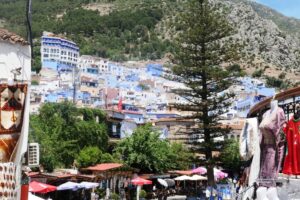
About 62 kms south of Tetouan lies the mountain town of Chefchaouen, one of the most unique places to visit in the country. Often called the “Blue City”, it’s famous for its striking blue-washed buildings and streets. There are numerous explanations as to why it is all coloured blue, ranging from religious symbolism, to temperature and mosquito control.
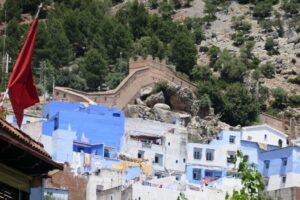
Chefchaouen is about 600m above sea level, in the foothills of the Ka’ala mountain which is in the western part of the Rif mountain range of northwest Morocco. The town offers fantastic landscapes for hiking and trekking, with great contrasts between arid plains and valleys, picturesque mountain peaks and flowing streams. The town’s buildings seem to tumble down the steep slopes of the surrounding mountains to form the town at the bottom.
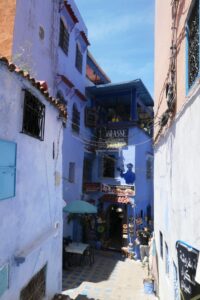
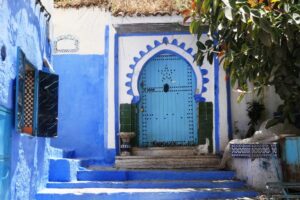
The town is home to many historic landmarks and architectural sites, and although there are no really major attractions in the town, the main enjoyment of visiting is that it’s more about exploring its beauty and tiny alleyways. It feels as though the entire town is built on a steep incline, with stairs leading up and down at every turn. The tall, narrow buildings are all a shade of blue, and the doorways are framed by textured walls, worn steps and contrasting tilework that only emphasise the blue. Some doors are adorned with local goods for sale, or decorative metal studwork in intricate patterns, or simple geometric shapes.
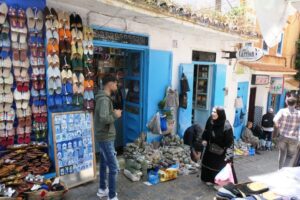
Chefchaouen is a smaller, slower-paced town compared to bustling cities, so that wandering about the town, even without a map, is a great way to discover hidden treasures and quiet little nooks and crannies. Everything is walkable, so no need for taxis or transportation, or even a guide. The Medina, with its narrow winding alleys, is an opportunity to mingle with the locals and to see their way of life.
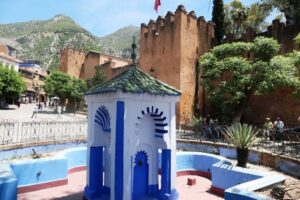
The town’s main square, Plaza Uta el-Hammam, is a market square surrounded by the most important buildings of the old town: the Kasbah, the grand Mosque and a caravanserai, as well as various shops and cafes. It is a buzzing hub of activity, with vendors selling everything from handmade pottery to traditional clothing. You can see people having lunch at rooftop cafes, and the locals going in and out of the Mosque.
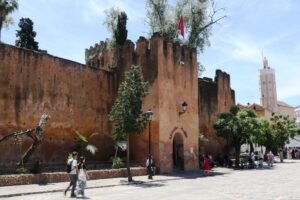
The oldest part of the Medina is the Kasbah, which was the original citadel founded by Ali Ben Rashid in 1471 as a small military fortress to defend it from the Portuguese armies. It consists of a more-or-less rectangular enclosure protected by walls built from rammed earth.
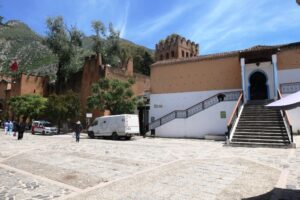
The original Kasbah had two entrances: one facing the main square and markets, another near the Great Mosque. These entrances have since been closed, and access today is though an opening created in the 1930s. The walls are reinforced by ten towers, and an additional tower on the west side. This tower is taller and stands out from the rest, and was probably built in the 16th century by Moulay Muhammad. Its structure and function appears similar to some of the tower-residences of Nasrid architecture in Grenada. Soon after the Reconquista of Granada, many Muslims and Jews fled to Chefchaouen to find refuge, which also explains the Spanish influence in much of the architecture.
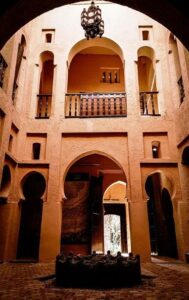
Today, the red-walled Kasbah has been converted into the small Kasbah Museum and its interior courtyard is now a garden. The museum’s exhibits are focussed on the town’s history and culture, and is home to a collection of old weapons, some photos of the city, and the town’s textiles.
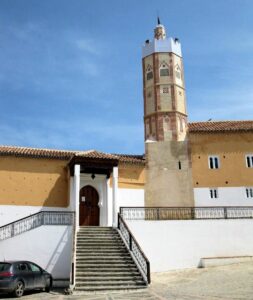
Just next to the Kasbah is the lovely Grand Mosque (Jamaa Kbeer). Though non-Muslims are not permitted entrance, its architectural uniqueness can be observed from the outside. It was built in 1560 by Moulay Mohamed, the son of Moulay Rachid, but its minaret, inspired by the Torre de Oro in Seville, was built much later, in the 18th century. The octagonal minaret features three tiers of blind arches that wrap around the tower, with each tier of arches being quite distinctive.
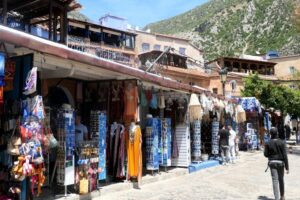
Just off Plaza Uta el-Hammam is Fonduq Chfichu, inhabited by wood and iron workers. There were once four or five major fonduqs—open courtyards surrounded by stables and shops that served as hubs for traders, artisans and shopkeepers in the medina. Today, this is the only remaining fonduq.
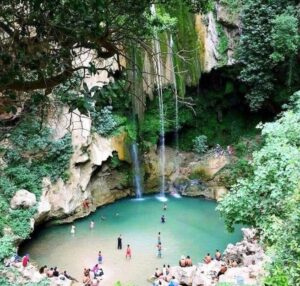
If you have the time to explore further afield, you can take a walk out of the town to visit the Ras el-Ma waterfalls, just beyond Place Sebanin. Another easy path starts at Ras el-Ma and offers the best view over Chefchaouen. At the end of the path is the Spanish-built mosque at the top of the hill overlooking the town. The mosque is closed, though it underwent a renovation in 2010, funded by Spain. However, most people walk up here to enjoy the view. A large terrace overlooks the valley. This is best visited in the morning if possible, when the sun is at your back, illuminating the white and blue town below.
These two delightful excursions are easily done, and cost-effective, from Tangier, hiring a car and driver. On the suggestion of the lady running our Riad, we simply approached one of the taxi drivers at the taxi stand in the Kasbah and asked if they would be interested—indeed he was, and said that most of the other drivers also do these excursions regularly. This method of getting around is very common throughout the country, although we rented our own car in Casablanca, which I will discuss in the next story.
Looking the pictures and reading about Chefchaouen- I wonder how you and Graham did not get lost. Did you take a ball of string? Or can you rely on maps of the town? I got so thoroughly lost in Ma’daba in Jordan even with a street map and no hills or stairs. Thank you for continuing to offer such wonderful insights into such towns and countries
Hi Anna,
No long ball of string required, nor did we have a street map–not sure if they even have one. Yes, it can be “interesting” walking around the maze of little narrow streets, but as the main square was on the top of a rise, we simply worked our way back up the slope, hoping we were going to finish up at the square–which we did! Chefchaouen is a delightful place in which to get lost.
Glad you enjoyed the story!
Cheers, Cheryl