

DISCOVERING COSMOPOLITAN TANGIER, MOROCCO’S NORTH COAST JEWEL
Known as “the white city”, Tangier stands at the Strait of Gibraltar, just 31 kms from the port of Tarifa over on the coast of Spain, and where the Mediterranean and Atlantic waters converge. The city has a long history as a cosmopolitan trading centre, and given its strategic location, was the subject of struggles between numerous empires, from the Romans and Byzantines, to the Imperial Portuguese and fascist Spain.
The Tangier we visited was something of a revelation. Along with much of what we’d read, numerous people had advised us not to bother with it, as it was regarded as so delapidated and dull, that it was a waste of time. Today’s reality was such a contrast to these comments. Certainly, by the early part of the 20th century, Tangier had declined into a seedy, run-down haven for shady dealers, vice and decadence. By the 1970s, Tangier had fallen into squalid disrepair.
Tangier has seen tremendous change in recent years. The city’s comprehensive cleanup and revitalisation took off under the current King, Mohammed VI, from the late 1990s and early 2000s. He implemented a major economic revival plan, backed by colossal investment, to upgrade basic infrastructure, housing and social services. The port was moved out of the bay to a new location to be able to deal with an increase in industrial shipping. The old port was transformed into a recreational, cultural and tourist space, which further encouraged a clean-up of the waterfront and the Medina.
The rich history of Tangier spans well over 2,500 years. In Greek mythology, the city is famously linked to the giant Antaeuis and Hercules, whose legendary battle was said to have formed the Strait of Gibraltar. It was first established as a Phoenician trading post called Tingis. The city was later absorbed into the Carthaginian Empire, and following the fall of Carthage, it came under Roman rule.
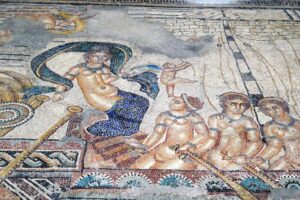
Following the Romans, Tangier was successively ruled by Vandals, Byzantines, Arabs and various European powers. These powers were all eager to control Tangier because of its unparalleled location as the gateway on the Straits of Gibraltar, where the Atlantic Ocean and the Mediterranean Sea intersect. It has been calculated that Tangier’s control has changed hands more times than almost any other city in North Africa.
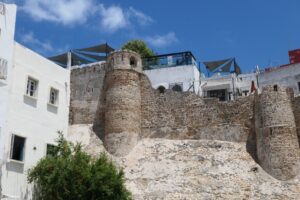
Throughout the 1400s and 1500s, Portuguese and Spanish forces vied for control of the port. In 1661, Tangier was gifted to the English Crown as part of the dowry of the Portuguese Princess Catherine of Braganza, but due to constant attacks by local Moroccan tribes, the English abandoned and largely destroyed the fortifications in 1684.
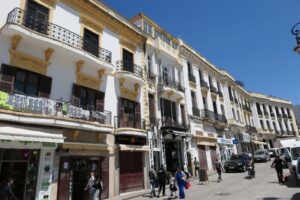
It became a diplomatic hub from the 18th – 19th centuries after rejoining Morocco. It slowly developed into the country’s primary diplomatic and commercial capital, and was the location of numerous foreign consulates and merchants.
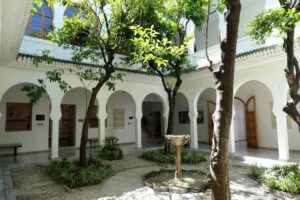
During George Washington’s tenure, the United States opened its first consulate in Tangier, and the Italian revolutionary Guiseppe Garibaldi lived in Tangier during his exile from 1849. By the 1870s, the city was the site of every foreign embassy and consulate in Morocco.
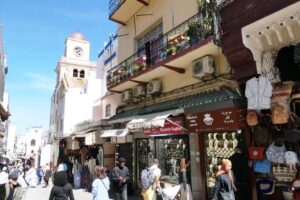
In 1923 Tangier was declared an International Zone to be managed by colonial powers, but the city’s international era came to an end shortly after Morocco regained its independence in 1956, and Tangier was officially reintegrated into the Kingdom. Today, the city retains its distinct cosmopolitan atmosphere while functioning as a modern industrial and commercial centre. So few cities combine history, an air of mystery and coastal beauty quite like Tangier. It is a meeting point of cultures, a city full of contrasts where Mediterranean calm meets African energy.
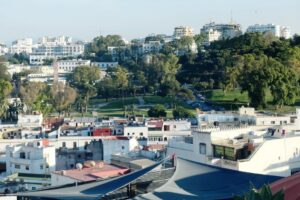
Tangier’s more recent history tended to focus on its bohemian reputation encouraged by its status as a tax haven with loose laws. From the early 1920s, it transformed into a legendary, cosmopolitan hub for European and American diplomats, spies, artists, and writers of the so-called beat generation such as William S. Burroughs and Paul Bowles as well as Tennessee Williams, Jack Kerouac and artist Henri Matisse. In the 1960s and ‘70s, Tangier formed part of the hippie trail.
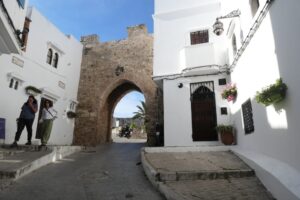
It’s a place where palm trees meet Art Deco, where every café echoes with stories of the past and where the sunsets looks like a postcard. Standing on the cliffs of Cap Spartel, you can literally see Spain across the water just 14 kms away, and Tangier’s coastline is one of Morocco’s most dramatic.
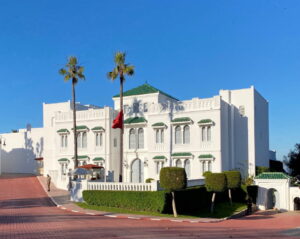
Today, many of the city’s historic buildings have been beautifully renovated, and now enjoy a second life in this thriving city. For example, former embassies such as the Museum of Contemporary Art in the former British Consulate, and palaces such as the former Sultan’s palace, the Palace of the Kasbah, now housing the Museum of Mediterranean Cultures, and the Mendoubia Palace, originally the former German legation building and now a museum of Moroccan resistance against colonialism. As well, the excellent Ibn Battuta Museum in the Kasbah is housed in a former historic fortified watchtower, the Borj Naam Fortress.
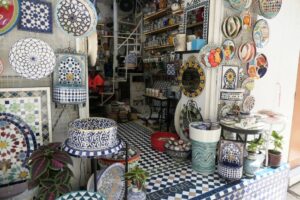
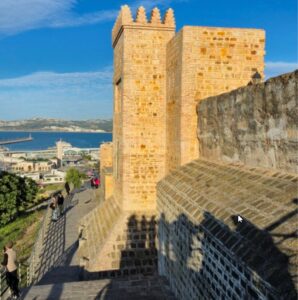
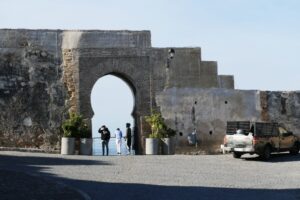
The most interesting part of the city for the visitor today is the Medina (“Old City”), which is where you’ll find the artisanal trades such as leather working, handicrafts made from wood and silver, traditional clothing and ceramics. The Medina is still surrounded by the remains of what was once more than 1,830 m. of stone ramparts and bastions, which mostly date from the Portuguese occupation.
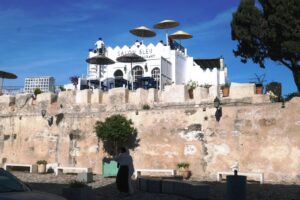
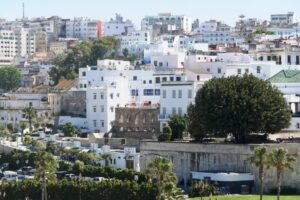
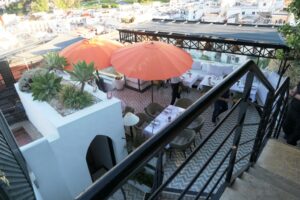
Perched at the highest point of the Tangier Medina is the Kasbah, defined as an historic 17th century fortress, or citadel, district. It features a labyrinth of whitewashed, narrow streets, with brilliantly coloured bougainvillea trailing over walls. There are many vibrant artisan shops—some of the best in the city—inviting Moroccan cafes and restaurants, some occupying the flat rooftops, offering stunning panoramic views across the Strait of Gibraltar to Spain.
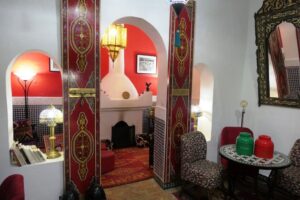
There are a number of delightful Riads (a type of Inn) in the Kasbah, and we were fortunate enough to stay in one of them, located down one of these picturesque narrow streets.
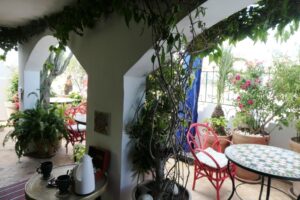
In spite of its perilously steep internal staircase, it turned out to be the perfect choice of accommodation, with lovely, traditional décor, all the expected modern amenities and a rooftop terrace with potted shade plants and easy chairs, in the most interesting location of this large city.
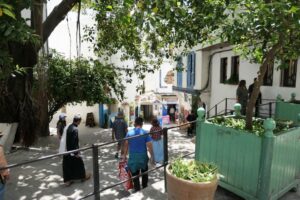
The central, bustling square, Place de la Kasbah, situated at the highest peak, makes it the perfect spot for photos. From here, it’s the place to start negotiating your way through the labyrinth of steep, winding, narrow alleyways, lined with whitewashed buildings, brilliantly coloured doorways and bright, potted plants. Adding to the atmosphere, the air is filled with the scent of fresh mint tea, spices and fragrant orange trees.
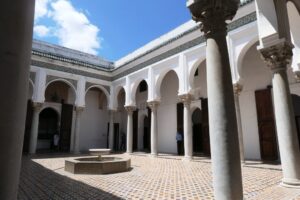
Located on the eastern part of the Kasbah is the former Sultan’s Palace, the Dar Al-Makhzen, now housing the Kasbah Museum, which has a fine collection of objects and has a fascinating history itself, as the site was used successively by Cathaginians, Romans, Portuguese, and English Governors, and later became a symbol of Moroccan authority.
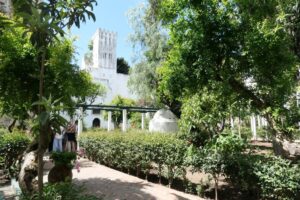
The current Palace was built by Ahmed Ben Ali, following the departure of the British in 1684. Over time, the Palace served as the seat of local power, and underwent numerous renovations and changes over the reigns of various Sultans. Set in a beautiful Moroccan garden, the museum certainly captures the essence of Morocco’s heritage, with its blending of traditional Moroccan design with Andalusian and European influences.
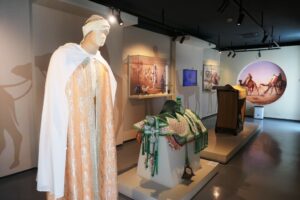
Just near the Kasbah Museum on Rue Riad Sultan, is the Ibn Battuta Memorial Museum, often called the ‘Borj A-naám Memories of Ibn Battuta’. This museum documents the extraordinary life and travels of the great explorer and scholar Ibn Battuta, who was born in Tangier in 1304. A fascinating story, and a visit to this museum is a very rewarding experience.
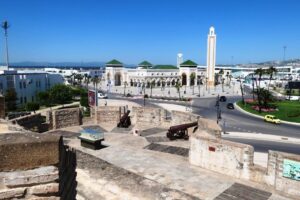
Down by the waterfront, the whole area has been cleaned up, and is a most pleasant area to visit and walk around. Head first to the big, landscaped roundabout with a large fountain in the middle, called Grand Socco, officially the Place du 9 Avril 1947, which separated the old medina from newer developments in the neighbourhood.
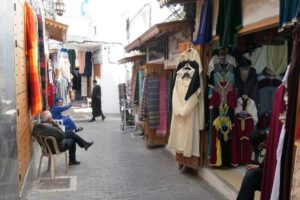
The Grand Socco is surrounded by a mosque, shops, several banks, and a number of cafes with covered outdoor seating areas.
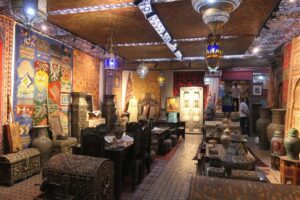
Almost next to the Grand Socco is the Mendoubia Garden, accessed through an archway, and a street lined in shops.
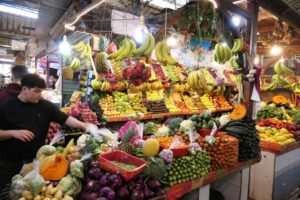
Also nearby is the main market, selling every conceivable item ranging from fresh fruit and vegetables to traditional Moroccan clothing, household goods and traditional craft stalls.
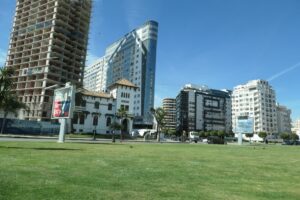
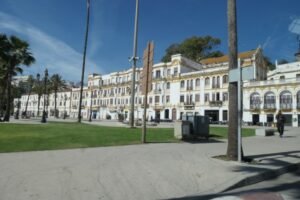
Along the waterfront there are now multi-storey 5 star hotels and resorts such as the Hilton, along with a shopping mall and quality restaurants. The seaside edge of this road is landscaped with grass and palm trees, and makes for a very pleasant place to stroll in the direction of the busy port along Ave. Mohammed VI. At the port, head into the area known as Petit Socco, which is lined with more traditional shops and businesses along its narrow streets.
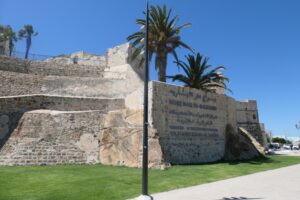
At the port, you will see a large structure, the Dar Al-Baroud Tower. Once a key defensive structure dating to the 15th century, with thick walls, battlements, and military equipment such as cannons that protected the city from invasions. The site now serves as a museum dedicated to the history of Tangier’s fortified buildings, featuring models, photographs and maps showing defences along Tangier’s coastline. This is a great place to climb its stairs from the lower level up to the top to enjoy a wonderful panoramic view of the coast.
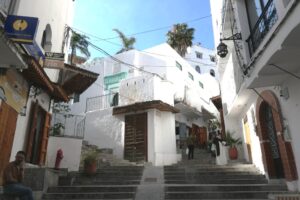
When you’ve finished your visit, you can exit at the top and continue up the steep slope, through the winding streets, and finish up back at the Kasbah.
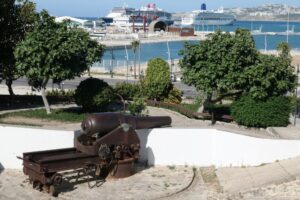
The entire waterfront area is indicative of Tangier now being an international city, offering every comfort and amenity, yet still preserving its cultural origins and distinctive Moroccan identity. The whole city is a visitor’s delight, with a feast of historic buildings and sites, opportunities to acquire traditional Moroccan crafts, eat delicious food and experience a living, vivid culture dating back thousands of years.
Leave a Reply