

MUSEUMS DEDICATED TO ARTISTS IN REGIONAL FRANCE
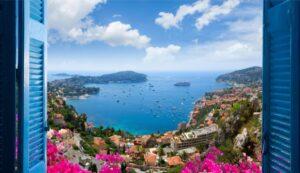
We have often been asked by fellow travellers if we know of any museums dedicated to specific artists or writers in particular regions in France. It’s always such a delight to come across a town or village with such attractions that enhances a visit, or becomes the reason to visit. There are indeed so many of these museums throughout the country that I have compiled a list, region by region. I would like to encourage any readers who have come across an unexpected treat that isn’t listed, to let me know so I can add it to the list for others to discover and enjoy.
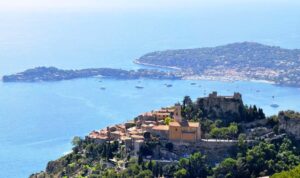
I’ll start this summary with the Riviera, since so many well-loved artists gravitated to this area from the late 19th century onwards, and is such a popular destination for visitors. Many of these museums are absolutely stunning, and not only worth a detour, but indeed can be the whole focus of a holiday trip.
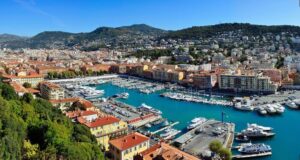
The obvious place to start exploring museums along the Riviera devoted to specific artists is surely Nice. It’s such an accessible city from anywhere in France with good air and rail links, and from there to locations along the coast and up into the hinterland, even just for a day trip for some of them.
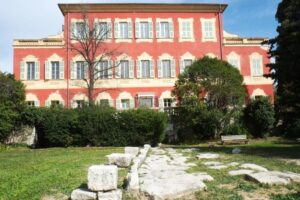
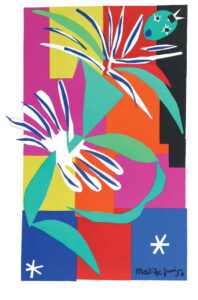
The first museum dedicated to an artist in Nice would have to be the Musée Matisse in the suburb of Cimiez, a former Roman city. Located on top of a hill in a lovely 17th century villa, it features a large collection of the artist’s works ranging from paintings, drawings and sculptures. The Matisse Museum was inaugurated in January 1963 and initially occupied the first floor—the ground floor being occupied by the Archaeological Museum.
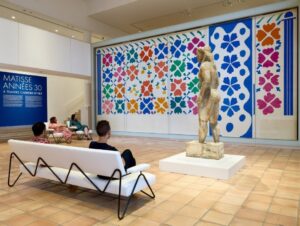
In 1978, following a large donation by Jean Matisse, one of the artist’s sons, the museum needed total refurbishment. Following the Archaeological Museum eventually moving into a newly constructed space next door, the Matisse Museum finally occupied the entire villa.
A beautiful villa with a relaxed atmosphere, it’s easy to get there from the centre of Nice on the Line 05 bus from near Roland Garros, heading to the ‘Arenes/Musée Matisse’ stop, and takes less than 10 mins. and costs about AUD$3.
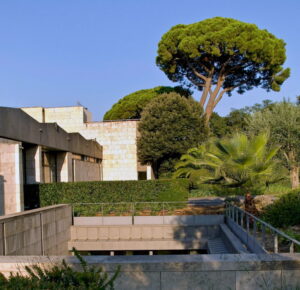
About 1.50 kms from the Musée Matisse, and taking the Line 05 bus back towards the city, is the Marc Chagall National Museum in Ave. du Docteur Ménard. The large, modern building is in a lovely garden setting that has a very pleasant, shady café called La Buvette du Musee, under the olive trees. One of the main features of the collection is Chagall’s ‘Message Biblique’ series, as well as all the preparatory work and numerous other works, including the 1931 Bible gouaches, 105 Bible engravings and their copperplates, plus an important collection of lithographs, 5 sculptures and 1 ceramic.
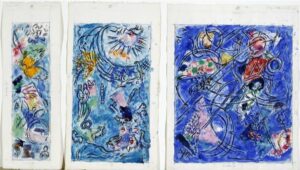
The collection was first built up from the initial donation by Chagall in 1972 of over 250 works, and continued to grow during Chagall’s lifetime. The posthumous donation in 1988 further enriched the museum with 10 biblical paintings. Subsequent donations from Chagall’s regular lithographer, who donated a very large collection of lithographs on biblical and secular subjects, as well as successive curators’ acquisition policy to further enrich the collection.
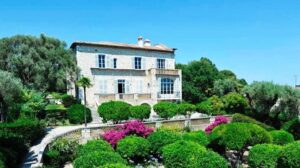
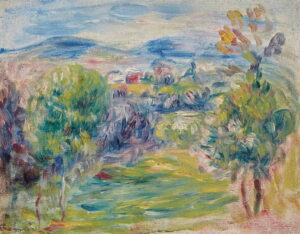
Further along the coast 15 kms from Nice heading towards Cannes, is Cagnes-sur-Mer, location of the Musée Renoir. Created as a museum in 1960, it was the final home of the painter and showcases the work and life of this brilliant artist through more than a dozen original paintings, objects and furniture as well as old photographs.
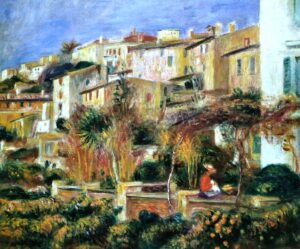
The home is set in a beautiful Mediterranean garden, planted with centuries-old olive trees, fig trees and orange trees. The garden level of the house displays sculptures by Renoir and his friend Richard Guino.
To get to the museum from Nice take the no. 620 bus, to Cagnes-sur-Mer, or the SNCF train which takes only about 15 mins., and at the train station, either walk or take the local no. 49 or 44 shuttle bus.
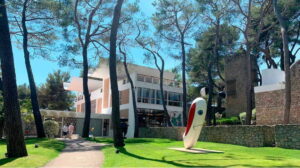
One of the most important galleries on the Riviera, indeed in the entire country, is the Fondation Maeght in the lovely town of Saint-Paul-de-Vence, in the hills above Cagnes-sur-Mer about 7 kms away, or 19 kms from Nice. This is always an absolute Must Visit for us when we’re in this part of the country.
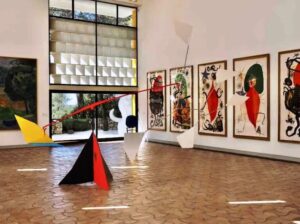
Some of the biggest names in 20th century art, including Georges Braque, Joan Miro and Alberto Giacometti, came together to help create La Fondation Maeght, now one of the world’s leading cultural institutions. It was established by Aimé and Marguerite Maeght, a visionary couple who were publishers and art dealers, and who represented, and were friends with the artists mentioned as well as Alexaner Calder, Fernand Leger, Marc Chagall, and many others.
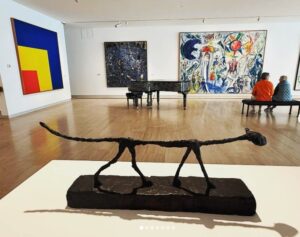
The Fondation was opened in July 1964 by Charles de Gaulle’s legendary Culture Minister, André Malraux, a close friend of the Maeghts. It was France’s first private art institution and was modelled on American institutions such as the Guggenheim Foundation. The complex was designed by one of the top architects of his day, Josep Lluis Sert. This is so much more than just an art museum, regarded instead as a venue to present contemporary art in all its forms, not only paintings.
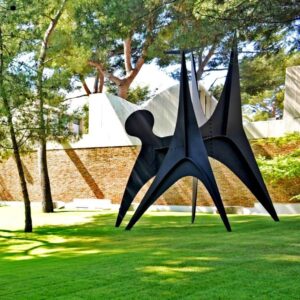
The sculpture garden is full of great works, and as well, there is a chapel, a home studio an excellent reference library and photographic archive. This wonderful place is open daily. When you’ve finished your visit, a stroll around the medieval town of St-Paul-de-Vence is a delight, with lots of cafes and shops, as well as the stunning view from this artistic mecca down to the Riviera coast below.
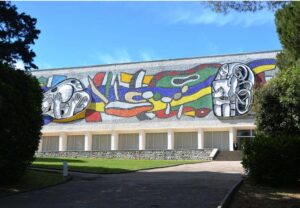
Heading further along the coast in the direction of Cannes, a few kms inland is Biot, location of the Musée National Fernand Léger, built by his widow Nadia and good friend and collaborator, Georges Bauquier. Designed by architect Andre Svetchine, and set in a landscaped park, the façade of this stunning building incorporates an immense mosaic, initially planned by Léger for the decoration of the Hanover stadium, but never produced. Under the patronage of Picasso, Braque and Chagall, the museum was inaugurated on 13 May 1960.
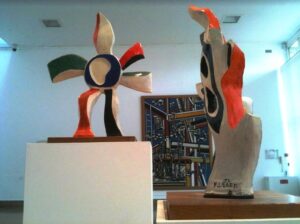
The founders donated the building, the land and a collection of over 300 works by Léger to the French state. Officially received by Andre Malraux, this event was celebrated by a grand gala at the Cannes Festival Palace. To get to Biot is quite straightforward. Take Line 630 bus from Nice or train to Cagnes-sur-Mer then a taxi 5 kms up to Biot.
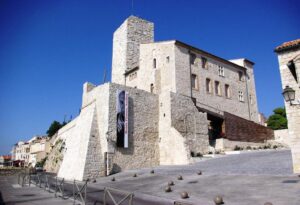
One of the most important art museums in France would have to be the Musée Picasso at Antibes. On 27 December 1966, Grimaldi Castle was turned into the Picasso Museum. Built on what had been the ancient acropolis of Antipolis, and then a Roman castrum and later a Medieval bishopric, it was owned until 1608 by the Grimaldi family, hence its name.
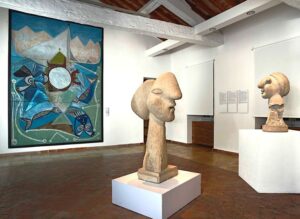
In 1925 the castle was acquired by the City of Antibes, and in 1946 the curator offered space in it to Picasso for a studio. From September to November of that year, Picasso created many works, sketches and paintings, including the massive ‘Les Clés d’Antibes’ (The Keys of Antibes) which covered an entire wall surface. When the artist decided to move back to Paris, he left 23 paintings and 454 sketches in the castle’s custody.
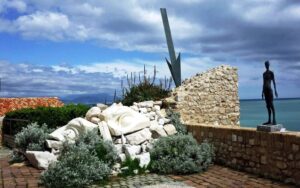
Works on show by the artist Nicolas de Stael are testimony to his stay in Antibes from 1954–55, and in 2001, a large donation by the Hans Hartung and Anna-Eva Bergman Foundation provided for the opening of 2 new galleries on the ground floor of the museum. The museum has a permanent exhibition dedicated to each of the artists associated with the castle over several decades. The terrace of the museum is home to a permanent collection of remarkable sculptures by Germaine Richier, Joan Miro, Bernard Pages, Anne and Patrick Poirier, although none by Picasso—these are inside the museum, along with numerous ceramic pieces.
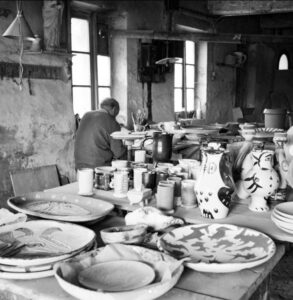
To see Picasso’s sculptures and ceramics, you need to head to the town of Vallauris. This lies 2.50kms inland from Golfe Juan and a little over 7 kms from Antibes. He lived in Vallauris from 1948 to 1955. At the time, he was living with Francoise Gilot and their two children, Claude and Paloma. Fascinated by ceramics, he began working with local artisans, and was introduced to the Madoura workshop: shaping, moulding, firing, forming and deforming. He quickly mastered the technique, creating numerous pieces, including his famous owls and mythological figures, jugs, plates and pots, in all some 4,000 works. The Madoura workshop is home to a permanent collection of ceramics by Picasso as well as Suzanne Ramié, and holds regular contemporary exhibitions. Madoura is located on rue Suzanne et George Ramié, Vallauris.
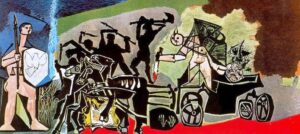
Also, notably, what’s also in Vallauris is the Picasso National Museum “War and Peace.” Spanning over 100m2, this monumental painting was crafted on panels of hardboard. It was painted in the artist’s studio in 1950 during the Korean War. As a member of the French communist party, Picasso campaigned for the Peace Movement, designing the dove that would go on to be used around the world. He decided to create an enormous work that would reflect his political views. In 1951, during a dinner in the nave of the castle’s chapel held by the Vallauris potters in honour of his 70th birthday, Picasso expressed his desire to decorate the vaults.
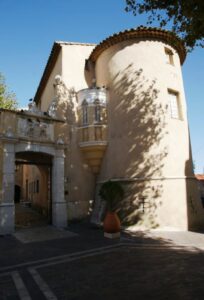
He had a vision of turning the old, deserted sanctuary into a sort of ‘Temple of Peace.’ He began work on the piece in August 1952 and once finished, the two panels were shown in Rome and Milan in 1953, and in 1954 they were installed in the chapel. In 1958, Picasso painted a 3rd panel, entitled ‘The Four Parts of the World.’ The whole work was gifted to the French State in 1956, and the site was granted national museum status shortly afterwards—the first of its kind outside of Paris.
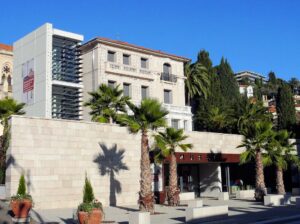
We are big fans of the works of Pierre Bonnard, and happily, there’s a museum in the hills at Le Cannet, about 32 kms from Nice, almost at Cannes. Musée Bonnard is the only museum in the world dedicated to this important artist’s work. Appropriately. It’s located in the heart of Le Cannet, a town whose landscapes and southern light inspired the artist, and it was during his time living here in his house Le Bosquet, from 1922 until his death in 1947, that he painted his most inspiring works, much like Sainte-Victoire did for Cezanne or Giverny for Monet. His new life in Le Cannet allowed him to maintain his friendship and artistic relationship with Henri Matisse, who was already living in Nice.
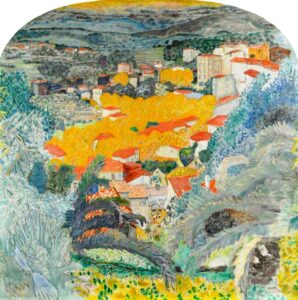
Musee Bonnard is located near Le Bosquet, and occupies a house in one of the last buildings of Belle Époque architecture, the Hotel Saint-Vianney. It was restored and adapted in 1998 to house Bonnard’s works, and officially opened its doors on 25 June 2011. It’s now regarded as one of the most important cultural institutions on the Riviera.
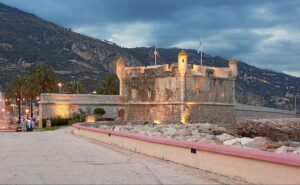
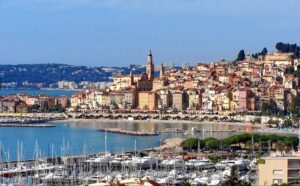
Finally, back to Nice, and beyond, almost to the Italian border, lies Menton. Here is an art museum dedicated to one of the most original artists of his era, and another great favourite of ours, Jean Cocteau. Comprising about 1,800 works by this artist, known as the Severin Wunderman collection, it has been housed in a former seafront fortress, and a former wedding venue. Cocteau himself found this neglected 17th century bastion on the seafront in 1957 whilst decorating the wedding venue. This is in fact the temporary home of the collection, since the municipal museum devoted to Jean Cocteau, which opened in 2011, has been closed since October 2018 due to massive storm damage.
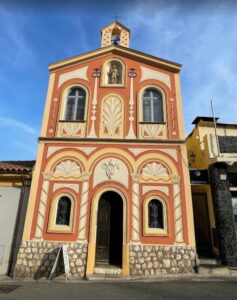
If you too are a Cocteau fan, on your way back to Nice stop off at Villefranche-sur-Mer and visit La Chapelle Saint-Pierre de Pecheurs on the waterfront, near the port. Decorated inside and outside by the artist the chapel dates back to the 16th century, but had been used by 20th century fishermen as a place to store their material.
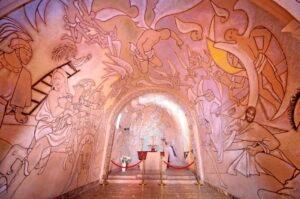
In 1957 Cocteau painted some wonderful frescoes, two scenes of Mediterranean life and 3 dedicated to Saint Peter. This is a real treasure. See it if you can!
We have explored here just a few of the outstanding art museums along the Riviera, and there’s lots more to discover in southern France. Many of these art museums hold regular temporary exhibitions that certainly warrant a return visit, even if you’ve been to a particular museum before. Many of our repeat visits to this magical coastal region, with its extraordinary light—the light that attracted so many artists in the 19th and 20th centuries—have been enriched by a special exhibition or two based around the work of many of our favourites.
Leave a Reply