

LE CHEMIN DU PUY PILGRIMAGE ROUTE TO SANTIAGO DE COMPOSTELA
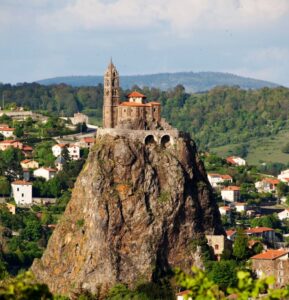
In the last two stories, we’ve followed two of the Medieval pilgrimage routes through France down to the border town of Saint-Jean-Pied-de-Port, where they all converge and head into Spain and across to Santiago de Compostela. All the routes offer an opportunity to explore some of the loveliest countryside and historic towns and villages in France, and this next route is no exception.
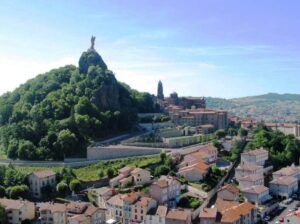
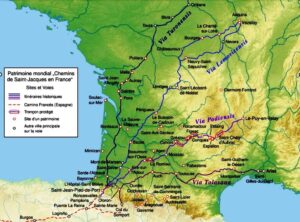
This third pilgrimage route, known as the Via Podiensis, is an approx. 745 – 750 kms trail which begins in the striking volcanic town of Le Puy-en-Velay, and said to take roughly 30 – 40 days to walk from there to Saint-Jean-Pied-de-Port. The upper town is a protected heritage area covering 35 hectares. Probably the most striking feature of the town is the nearby chapel of Saint-Michel d’Aiguilhe, perched atop an 85 metre volcanic “needle”. Built in 962 CE, and requiring a climb of 168 stone steps carved into the rock to reach, it’s certainly a chapel with a view!
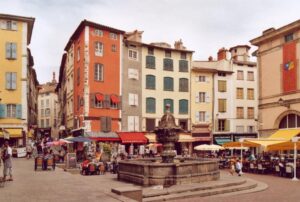
Some of the numerous highlights of this town include the many well-preserved ancient houses featuring delightful architectural details such as turrets, sculpted doorways and mullioned windows, all of which give the town its distinctive character, making it a treasure for visitors to explore.
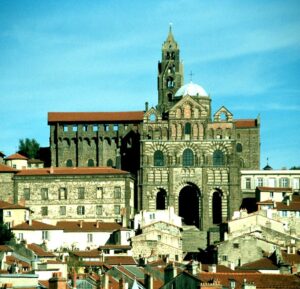
Also make sure to visit the 12th century Romanesque Cathedral of Notre-Dame du Puy, a UNESCO World Heritage Site. Another sight you’ll see is the impressive bronze statue of Notre-Dame de France, which was made from 213 Russian cannons taken during the Siege of Sevastopol (1854-55). This striking monument stands as a symbol of protection and strength for the town and its pilgrims.

Le Puy-en-Velay is famous for its long-standing tradition of lace-making. The town’s intricate hand-made lace has been a cherished craft for centuries. Today, the tradition continues through the National Academy of Lace, which preserves and promotes this beautiful art form. Visitors can learn about lace-making history and even purchase a delicate, handcrafted piece as a souvenir.

Another regional speciality is the Le Puy green lentil (lentille verte du Puy). Grown in the thin, volcanic soils surrounding that town, these small, dark lentils have a unique taste and texture. Their high protein and low carbohydrate content make them popular for soups and dishes such as goose, duck and sausage. The lentils are so distinctive that the European Union has granted them a Protected Designation of Origin (PDO).
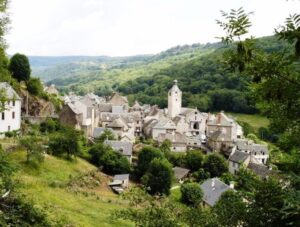
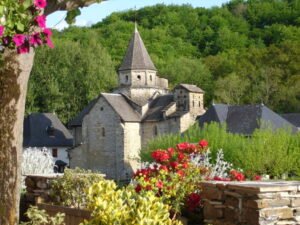
Having left Le-Puy-en-Velay, your first stop on your walk is a great introduction to the Via Podiensis Route. It’s 126 kms to the little village of Saint-Chely-d’Aubrac, halfway between the Aubrac plateau and the Lot valley, set in a large and beautiful green, steep-sided valley. Going down a wild, wooded valley, the walker discovers the village in a large clearing, and you enter the town by the old bridge with its pilgrim’s cross, just like the pilgrims of the past. The village is recognised by UNESCO as part of the Routes of Santiago de Compostela in France, and the so-called Bridge of Pilgrims is specifically named as part of this designation.
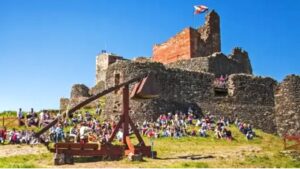
Just 20 kms further along the Route you will come to Espalion in the Lot Valley, a pretty village that overlooks the pastures of the Monts d’Aubrac to the north and the Causse Comtal to the south. This once-fortified town is an essential stop-off point along the Route, and the ruins of Calmont d’Olt castle dominate a hill overlooking the town. Jousting and archer challenges are held regularly in the castle grounds.
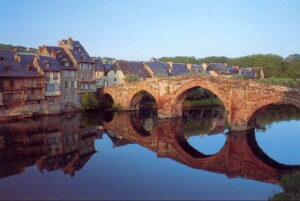
In its historic heart, you will see some remarkable pink sandstone buildings, the symbols of its past political and religious power. Between two bridges over the Lot, are former tanneries with their galleries and wooden balconies, which serve as a reminder of one of the town’s most prosperous industries. Standing on the Pont Vieux built over the Lot, you can admire the reflection of its arches and that of the Renaissance Palace on the banks of the river.
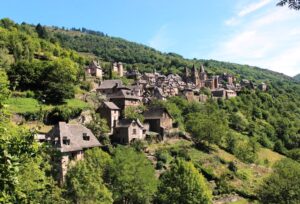
Your next stop along the Route is one of our favourite destinations in this region, the stunning medieval village of Conques. Built on a hillside, it has classic narrow medieval streets, so is mostly pedestrianised, since buses and large vehicles cannot fit down the streets of the historic centre.
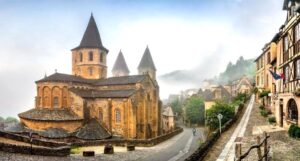
The Abbey Church of Sainte-Foy was a popular stop for pilgrims, who sought out the remains of Saint Faith (Sainte Foy), a young woman who was martyred in the 4th century. The original monastery building at Conques was an 8th century oratory built by monks fleeing the Saracens in Spain. This building was later rebuilt in the 11th century to better accommodate the relics of the saint and the increase in pilgrims on their way to Santiago de Compostela. The Romanesque Abbey Church is a designed UNESCO World Heritage Site, and the village itself is one of the Plus Beaux Villages de France.
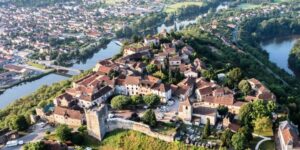
Pressing on, the next stop on the Route is Figeac. Classified as a city of art and history, Figeac has been recognised by the Midi-Pyrenees Regional Council as one of the 18 Great Sites of Occitania. Evidence of its rich history can be seen in the old town’s layout and winding streets of the Middle Ages, with many buildings from the 13th – 16th centuries and its old sandstone mansions built by successful merchants and bourgeoisie.
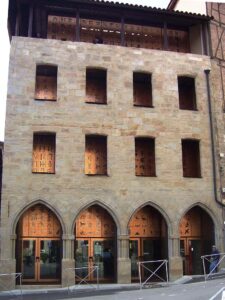
One of the famous sons of Figeac was Jean-Francois Champollion. In 1822, he not only deciphered the Rosetta Stone, but also uncovered the secret behind Egyptian hieroglyphs and much more about Egyptian history and culture. Visit the Musée Champollion on Place Champollion to learn about the life work of this extraordinary scholar.
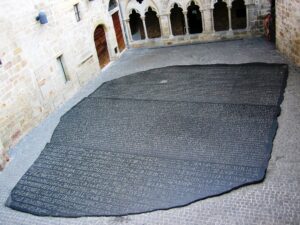
Set in the pavement at Place d’Ecrites is a giant reproduction of the Rosetta Stone. Place Champollion, along with Place Carnot, are poplar areas with restaurants featuring outdoor terraces. Note too that there is a covered market at Place Carnot on Saturday mornings.
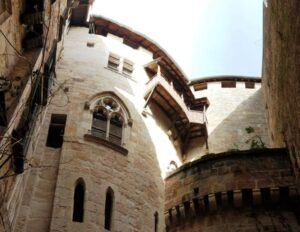
Other sites to visit in Figeac are Église Notre Dame du Puy, that affords great views of the village from the terrace, and Saint-Saveur Abbey, founded by Benedictine monks from Conques in 838. It became an abbey in the 12th century and showcases beautiful stained glass windows, Romanesque and Gothic art, and outstanding carved wooden panels in the side chapel. The Knights Templars established a commanderie in Figeac in 1187. Located on rue Gambetta, it’s now a museum with excellent displays about medieval life. The top floor offers excellent rooftop views of the town.
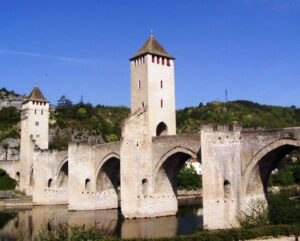
17 kms further on you will pass through Gréalou, and from there it’s 56 kms to Cahors, one of the Must See destinations in the entire region. Nestled into a fold of the River Lot and surrounded by steep hills, this historic city has great diversity from its Celtic origins, then the Roman era and through to the Middle Ages. Sights to see include the Roman walls, the 12th century Cathédrale Saint-Etienne, and especially the famous Gothic-style, fortified Valentré bridge, which itself is a UNESCO World Heritage Site, and the symbol of the town.
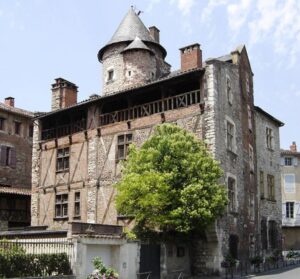
There are many interesting sights in Cahors, such as the 15th century Maison Henri IV, usually referred to as Hotel de Roaldés, the 14th century Saint-Barthelemy Church, the fortified gateway—or barbican—that once defended the Barre Gate, The Palais Dueze, the Arc de Diane—the remains of the ancient Roman baths—and the remains of a Roman amphitheatre.
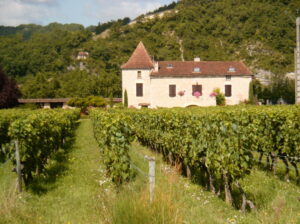
The other thing that Cahors is famous for is its wine production, primarily its robust red, which must have a majority of Malbec grapes, usually blended with Merlot or Tannat. There are a number of tasting rooms where you can sample the local products. Ask the local Tourist Office for details.
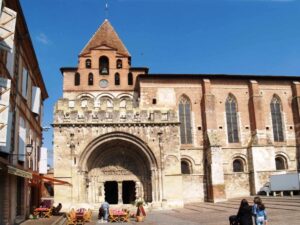
Next on the Route is the town of Moissac, a little over 63 kms from Cahors. You are now in the Tarn-et-Garonne department. The town is situated at the confluence of the Garonne and Tarn rivers, meeting at the Canal de Garonne. Unfortunately, much of the town was destroyed by terrible floods in 1930, although the great medieval abbey was untouched, and well worth stopping for a look.
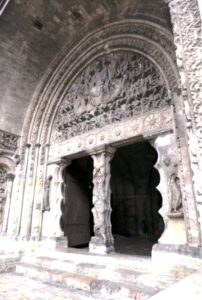
Listed as a World Heritage Site, the Saint-Pierre Abbey Church has a portal built in 1130, that is regarded as one of the masterpieces of Romanesque sculpture. All that remains of the 11th century building is the massive bell tower-porch, a sort of keep with a walkway, built for defensive purposes.
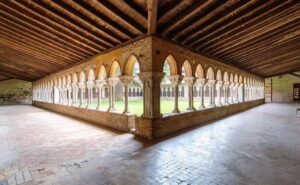
The church’s cloister is reputed to be one of the most beautiful cloisters in the world, with its 76 marble columns and a myriad of fine carvings on the capitals, all surrounding a pretty courtyard garden.
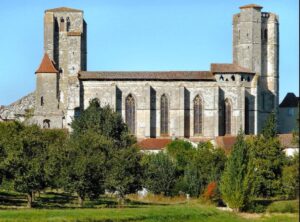
From Moissac, you will arrive at the village of La Romieu, 80 kms further along the Route. It has a magnificent 14th century collegiate church, St. Peter’s, which is classified as a UNESCO World Heritage Site. The village is also a medieval bastide, with the typical architecture of the Gers, Gascony region, and is a designated Plus Beaux Village de France.
Further along the Route you will pass through the villages of Beaumont-sur-l’Osse, Aire-sur-l’Adour, and L’Hôpital-Saint-Blaise, with its 12th century Romanesque church of the same name. You are now in the Pays Basque, and in 56 kms you will reach Saint-Jean-Pied-de-Port.
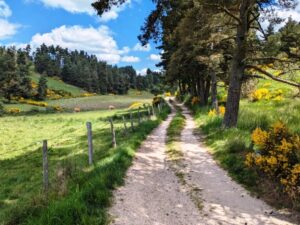
If you started your pilgrimage walk from its start at Le-Puy-en-Velay in the Haute-Loire, you will have travelled through some of the loveliest countryside in France, from gentle hills to the foothills of the majestic Pyrenees, and explored historic villages and exceptional monuments. As a bonus, you will certainly have enjoyed great food and excellent local wines, as well as some local Armagnac cognac to further enhance your experience.
Leave a Reply