

PAROS –IN THE MIDDLE OF THE AEGEAN, AT THE HEART OF THE CYCLADES
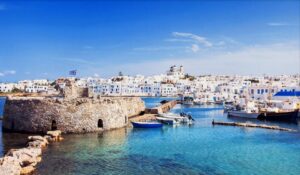
We had sailed past the island of Paros a number of times in the past, but were always en route to somewhere else in the Cyclades such as Santorini, or Naxos, which is just 8 kms away. We determined this time around that we would make a point of stopping there for a few days and explore what had looked to us, peering across at it from the deck of a huge ferry, to be a picturesque town with pretty beaches and bays full of boats, large and small. What a gem it turned out to be!
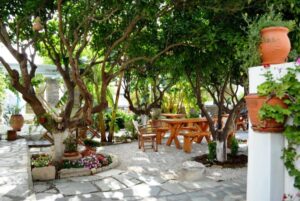
There is a good choice of accommodation, but wisely, as it turned out, we chose a small, family-run hotel a couple of streets back from the waterfront, that had a beautiful, leafy, quiet courtyard for guests’ use, and where a delightful breakfast was served every morning. The waterfront is lively, and filled with charming little cafes and tavernas, leafy, cobbled side streets, lined with smart little boutiques, a few good quality souvenir shops—a number featuring items locally made from olive wood—and a selection of shops mostly for local patronage, indicating that the island isn’t just kept alive for visitors–as is the case with some destinations.
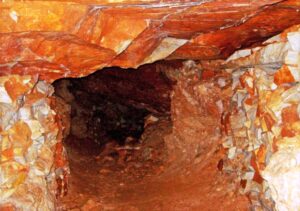
Historically, Paros was known for its fine, white marble, which gave rise to the term ‘Parian’ to describe marble or fine china of similar qualities, and was the chief source of wealth for the island. Today, there are still a couple of marble quarries still operational on Paros, and quite a number of abandoned ones. Nevertheless, the island is primarily known these days as a tourist destination.
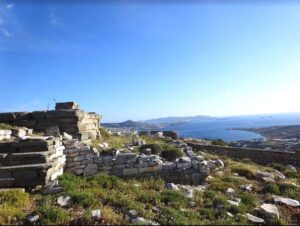
The mythological origins of Paros say that the island was colonised by Arcadians, and there are a number of ancient names that the island was known by, such as Plateia, Strongyle (meaning round, due to the round shape of the island), Minoa, and numerous others. However, it is known that Athens sent a colony of Ionians, under whom the island achieved a high degree of prosperity. The island in turn sent out colonists to Thasos and Parium on the Hellespont (which we know today as the Dardanelles). Paros seems to have been a dependency of Naxos shortly before the Greco-Persian War, referred to as the Ionian Revolt, that started around 499 BCE, but in the First Persian War of 490 BCE (which we mostly remember because of the Battle of Marathon), Paros sided with the Persians and sent a trireme to Marathon to support them. Strategically, this was a bad move on the part of Paros, as in retaliation an Athenian fleet under Miltiades besieged the island, who demanded a fine of 100 talents. However, the island put up a vigorous resistance, and the Athenians were obliged to sail away after a siege of 26 days, during which they had lain waste to the island. Paros took it as a favourable sign from the gods that Miltiades received a lethal wound while ransacking a temple of Demeter, and died soon after. Archaeologists, following the description of it by Herodotus, have identified the remains of this temple on a low hill beyond the boundary of the town.
Paros also sided with Xerxes l of Persia against Greece in the second Greco-Persian War, although it remained on the sidelines after the Battle of Artemisium. For their support of the Persians, the islands were later punished by the Athenian war leader, Themistocles, who exacted a heavy fine. In later years, the huge contribution by Paros to the Athenian-dominated Delian League naval confederacy, implies that Paros was one of the wealthiest islands in the Aegean.
Paros and the other Cycladic islands were subjected to the reign of the Ptolemies, the Hellenistic dynasty of 305-30 BCE, which ruled Egypt. Paros then became part of the Roman Empire, and later of the Byzantine Empire, its Greek-speaking successor state. During the Crusades, Paros was ruled by a Venetian duke as a vassal state of the Republic of Venice. In 1537, Paros was conquered by the Ottoman Turks and remained under the Ottoman Empire until the Greek War of Independence.
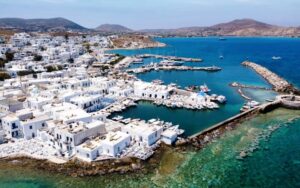
During the Russo-Turkish War of the mid 1700s, Naoussa Bay was the home base for the Russian Squadron of Count Orlov until it finally became part of the newly independent Kingdom of Greece in 1832. It was the first time that Paros had been ruled by fellow Greeks for over 6 centuries. This was only interrupted during WW2, when the Axis powers occupied Greece.
Paros was originally occupied by the Italians until 1943, when the Nazis then took over, imposing a brutal and sadistic regime before finally being defeated by the Allies.
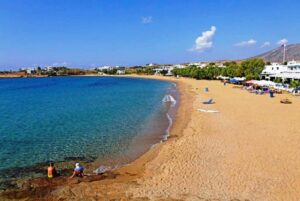
It’s difficult to imagine the extraordinary, often violent, history of Paros when you visit it today. Despite being a popular island for visitors, it’s easy to explore and relax on one of its quiet, beautiful beaches at your own pace.
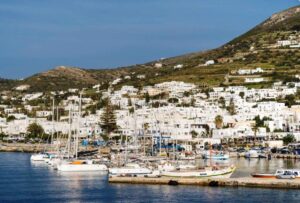
The main port of Parikia is the capital of Paros located on the island’s western side. It’s very typical of other Cycladic islands, as you can see when you explore its narrow, cobbled streets, numerous historic churches, the small shops, waterfront restaurants and the whitewashed houses with blue timberwork. In ancient times, the port of Parikia gave Paros its strength and made it a great naval power.
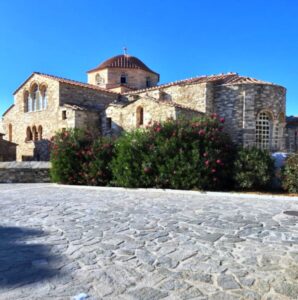
The most famous monument in Parikia is the church of Panagia Ekatontapiliani, which means “the Church of 100 doors”. This magnificent complex was originally built in the 4th century CE on the site of an ancient gymnasium, and remodelled in the mid-6th century CE during the reign of the Byzantine Emperor Justinian the Great. Today, you can see many interesting frescoes on its walls, and the complex houses the Ecclesiastical Museum of Parikia. There are also a number of other interesting monasteries not far from Parikia, such as the Monastery of Logovardas, the Monastery of Saint Anargyroi and the Monastery of Jesus of the Forest.
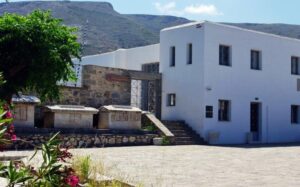
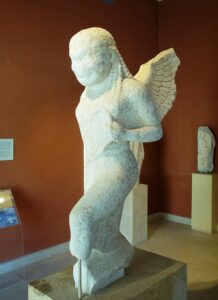
Quite close to the Church of a 100 doors, a visit to the Archaeological Museum in Parikia is a very rewarding experience, with a lot of marble sculptures and objects from the island’s ancient past.
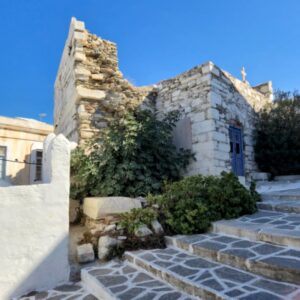
Just 2 mins. down the hill from the Church of 100 Doors you will see signposts to the remains of the Frankish castle, built in the 1200s by the Venetian Sanoudo family on the site of an ancient acropolis. Researchers believe that the castle was built from the remains of an assortment of ancient sanctuaries that were scattered in and around the island. Its walls and defensive tower are town landmarks. The western and northern part of the castle wall is believed to have become submerged into the sea after a coastal landslide in the 18th century.
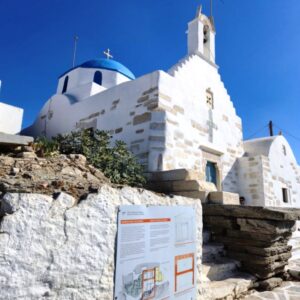
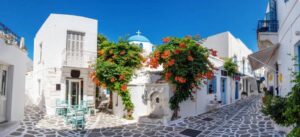
Another beautiful church, which you will see if you take a walk around the waterfront, is the Church of St Constantine. Built partly on the remains of the Temple of Athena, today it is typical of the Cyclades, with its whitewashed ancient walls, blue dome, surrounded by bright pink bougainvillea, perched on perhaps the highest point overlooking the town. You are sure to come across painters and picnickers enjoying the tranquillity and stunning views.
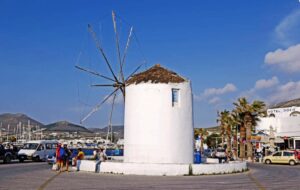
In the centre of Parikia you can see some fine neoclassical mansions that now house various public institutions and services. The main landmarks of Parikia are the preserved windmill right on the port, and the Venetian Castle on the top of the village, which was built by the Venetians in the early 17th century. There is also the small Archaeological Museum of Paros in Parikia, as mentioned, which houses some of the many finds from sites across the island, although the best pieces were taken to the National Archaeological Museum in Athens.
One of the most popular, and pleasant things to do on Paros is to take a bus from Parikia (if that’s where you’re staying) across to Naoussa, one of the island’s most popular villages, with its maze of alleyways and traditional, white-washed Cycladic houses, many of which are grouped along the port.
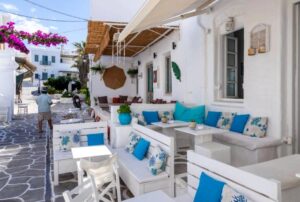
It’s the island’s most cosmopolitan village, and home to some of its best restaurants, tavernas, bars and boutiques, selling some of the most desirable resort wear for women and men, that you will find anywhere in Greece. There are a couple of very smart, small-ish resorts on the outskirts of Naoussa that you wouldn’t find elsewhere on the island.
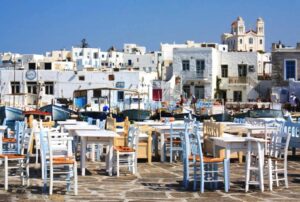
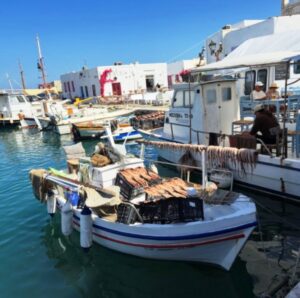
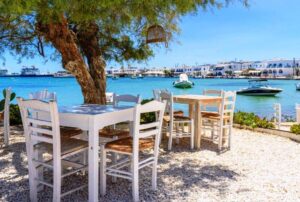
Despite this description of Naoussa, it isn’t overdeveloped or too busy, although there’s definitely a pleasant buzz, especially around its lively waterfront lined with inviting-looking cafes set up with their white tables and blue chairs. Take a while to sit and linger, and watch fishermen drape dozens of octopus along waterfront railings, which are sure to feature on local menus later that day.
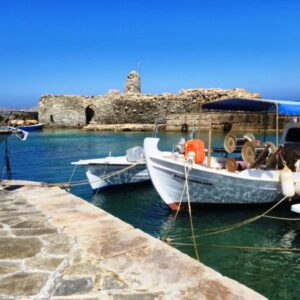
Right at the end of a stone walkway jutting out into the bay of Naoussa are the remains of a small fort, built in the late 13th century by the Venetians who occupied Naoussa from the 13th – 16th centuries. The fort was renovated in the 14th century by the ruling family Sammoripa, to protect Naoussa from invaders, chiefly pirates. Due to its architecture, it was very difficult for enemy ships to approach the port, but eventually, in 1537, Naoussa’s fort failed, and the island was looted by the infamous pirate Barbarossa. Nowadays, just a part of the fort has been preserved, namely a half-submerged watchtower that is connected to the land by the walkway.
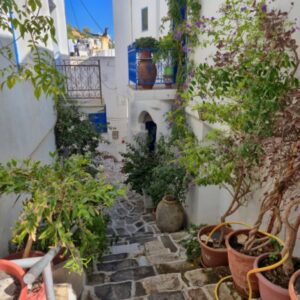
Taking the same bus from Parikia to Naoussa, it’s easy to take a detour to the beautiful village of Lefkes, a Must See on the island. From the bus stop, you walk down a slope through the charming historic town, with narrow, pedestrianised stone laneways, beautiful traditional and neo-classical buildings, delicious tavernas, friendly locals bidding you a cheery hello.
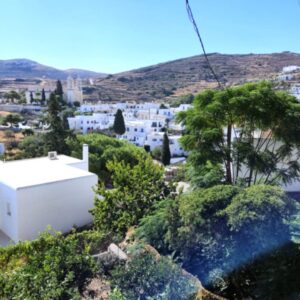
The town was built in the 17th century as a protected enclave from the rampant piracy that plagued the Mediterranean and Aegean waters during this period. Lefkes was well concealed from the sea, perched in a protected position, nestling in a valley and surrounded by olive groves, pine trees and farmland. At one time, Lefkes was the capital of the island.
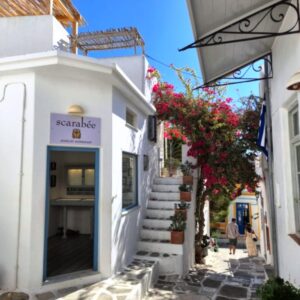
Enjoy a leisurely stroll along the ancient alleyways, and having a coffee and traditional Greek pastry under a vibrant bougainvillaea or shady tree at a kafénion (café).
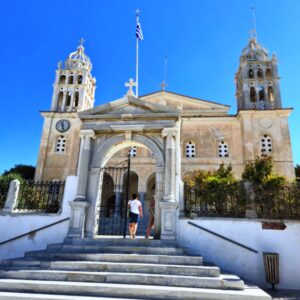
In the town, the most important, and prominent building is the grand Byzantine Agia Triada church, constructed from fine white local marble. With rare and valuable Byzantine icons housed within, Agia Triada is one of the most important on Paros. The location of Lefkes offers breathtaking views over Paros and also the neighbouring island of Naxos.
A lovely morning’s excursion from Paros, or even a whole day, is to take a short ferry ride from Pounda Port on the southeast side of the island across to Antiparos, towards the southeast. The ferry runs every couple of hours, and the trip only takes about 10 mins. The alternative is to take one of the passenger ferries from Parikia, which take around 30 mins.
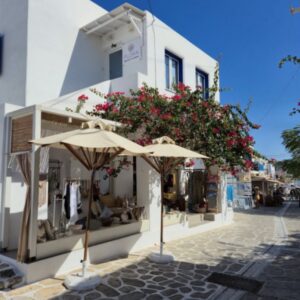
There is a small, pretty main town, and some popular, beautiful beaches such as Psaraliki Beach and Soros Beach, known for its crystal-clear waters. Attracted by its peace and relative quiet, actor Tom Hanks and his wife (who has a Greek mother), bought a stone house standing on about 2 – 3 hectares of land, between the tiny villages of Glypha and Chora. The couple can often be seen going to local church services and shopping in the local food market, as it seems they both love to cook.
Paros is such a delightful destination, having finally visited it, we can understand why it attracts the sort of visitor who likes something low key, yet still with lots to see and do and of course, it’s an ideal place to refresh a summer wardrobe! Best of all though, the whole island has an authentic charm that will stay with you long after you depart.
Leave a Reply