

THE PILGRIMAGE ROUTES THROUGH FRANCE TO SANTIAGO DE COMPOSELA
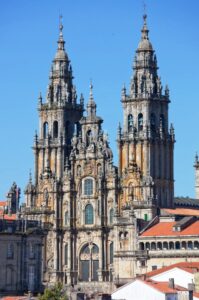
Throughout the Middle Ages, Santiago de Compostela was the supreme goal for countless thousands of pious pilgrims who converged there from all over Europe. To reach Spain, most of these pilgrims had to pass through France, and there are a number of scenic routes from which the modern day pilgrim can choose. Your choice will depend, naturally, on the amount of time you have available, although the hardest decision will be deciding which of the historic villages and medieval monuments you wish to explore en route. Whichever one you choose, you will certainly experience a great sense of accomplishment as you finally reach your destination of the Cathedral at Santiago de Compostela.
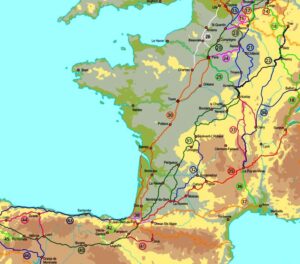
The pilgrimage routes are all listed on the UNESCO World Heritage List, with 71 edifices and buildings, some of which are richly decorated monuments while others are modest churches or stops for contemplation or rest, all located on the routes . The shortest, and best-known is from Saint-Jean-Pied-de-Port, and takes approx. 30-35 days for the 800 km journey. I will explore some of them over a couple of blog stories, and here I will start with the furthest from Santiago de Compostela, the so called Via Turonensis, which spans over 1,000 km (some sources say around 1,500 kms) from Paris to the Pyrenees.
Despite its length, it’s considered the easiest, flattest route, traversing western France, through Orleans, Tours, Poitiers and Bordeaux, before joining up with 3 of the other routes in Ostabat, a small town a short distance north of Saint-Jean-de-Port, where all the routes meet up. As there are no steep gradients, it is sometimes preferred by those travellers on foot and cyclists, as well as others on horseback.
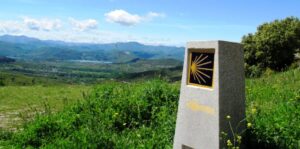
Nevertheless, this route is now the least popular of all, probably due to the time it takes to reach the end. One advantage though is that the route can be taken at any time of year. In the Ile-de-Frace region, the Camino route is marked with the scallop shell symbol, blue and yellow stickers or sometimes even nails in the ground, but unfortunately, some of the markers en route have been hidden under major roads or even motorways. However, it’s well-known which principal towns the route historically passed through.
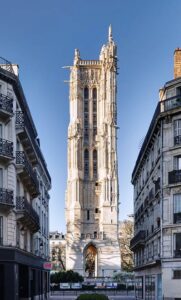
The Via Turonensis—or Way of Tours route—begins at the foot of the majestic Tour Saint Jacques on the Right Bank in the heart of Paris, near Chatelet. Take the rue St Martin and cross the Seine to Ile de la Cité by Pont Notre-Dame, continue along rue du Petit-Pont, which becomes rue St Jacques, so named because an order of Dominican monks opened a hospice for pilgrims heading to Santiago de Compostela. Walking to the edge of the city, a distance of less than 5 kms from Tour St Jacques, much of it along an old Roman way, it passes through interesting neighbourhoods and historic sites.
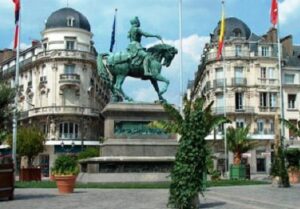
The route heads south to Tours passing through either Orleans or Chartres. Orleans in the Loire Valley is of course associated with Joan of Arc and there’s a statue to the “Maid of Orleans” in the main square, Place du Martroi.
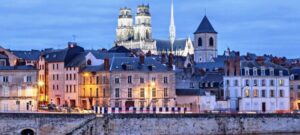
Don’t miss the stunning Cathédrale Sainte-Croix, the 15th century Hotel Groslot and the beautiful Parc Floral de la Source. There are some lovely scenic walking paths along the Loire River.
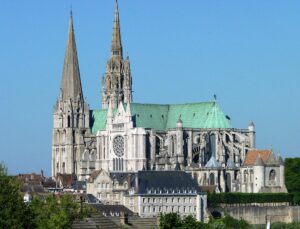
Alternatively, instead of Orleans, you can head to Chartres, our personal favourite of the two. It has one of the most remarkable and famous Gothic cathedrals in Europe, and is a UNESCO World Heritage Site in its own right. The town itself is pretty, with a lively, pedestrian-friendly historic centre with its many half-timbered 16th century houses, such as the Saumon house, the Voûte house and the houses in rue des Ecuyers.
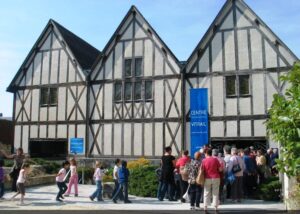
Not far from the cathedral is the international Stained Glass Centre, housed in the attic and cellar of Loëns house, which is dedicated to the art of stained glass window-making and restoration. In the evening from April to Sept., Chartres’ architectural heritage treasures are lit with stunning illuminations, culminating in the Festival of Light in Sept. Take a walk through the Lower Town, with its bridges, historic laundries, some of the town’s oldest houses and typical streets.
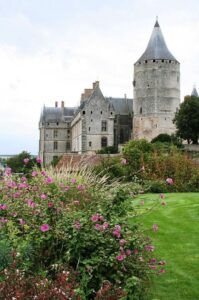
From Orleans or Chartres, you will head to Tours, passing through Châteaudun, with its medieval streets, Renaissance architecture, Château de Châteaudun and the underground Grottes du Foulon. You will then go on to the enchanting Vendôme with the river Loir running through it. Known for its flowers adorning the town, there is an 11th century, flamboyant Gothic Abbaye de la Trinité, and the ruins of the Bourbon-Vendôme feudal castle to explore, perhaps finishing your visit with a relaxing boat trip on the river before continuing on your way. You will pass through Château-Renault, an historic town known formerly as the “City of Leather”, it has a 17th century château, now the Hôtel de Ville, and the unique Musée du Cuir et de la Tannerie, set in a 16th century workshop, before reaching Tours.
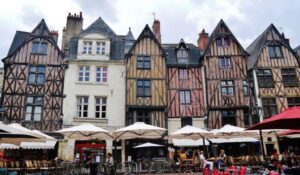
Located in the heart of the Loire Valley, Tours is renowned for its stunning architecture, vibrant, medieval Vieux Tours (Old Town) and as a great base for exploring the many châteaux nearby, such as Villandry, Chenonceau and Azay-le-Rideau. The main attractions in the town itself include, Place Plumereau, a bustling, pedestrianised square surrounded by lovely 15th century, half-timbered houses filled with cafes and restaurants, the Gothic Cathédrale Saint-Gatien, the Musée des Beaux-arts, and the Basilica Saint-Martin, over whose tomb it was built. Located near the river, Château de Tours often hosts special art exhibitions. Tours is also well-known as a culinary destination, and the nearby Touraine vineyards.
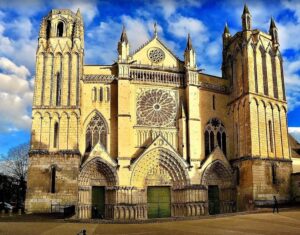
Heading south, Poitiers is next. A dynamic city combining rich medieval history with a lively, rather youthful, atmosphere. The pedestrianised centre features delightful, walkable streets, picturesque alleys, half-timbered houses, countless cafes and markets. There is the Church of Notre-Dame-la-Grande, a major Romanesque masterpiece, with an intricately carved façade and a stunning interior. You won’t miss the gothic style Cathédrale Saint-Pierre, and Baptistère Saint-Jean, considered one of the oldest Christian buildings in Europe, and the Palais de Justice, formerly the palace of the Counts of Poitou and Dukes of Aquitaine. Take a well-deserved rest or leisurely walk through a large, French-style garden, the Parc de Blossac.
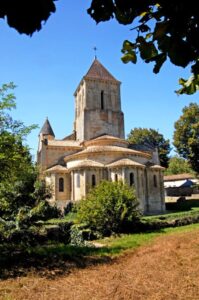
30 kms further on you will reach the small town of Melle, with its rich Romanesque heritage, specifically 3 historic 11th-12th century Romanesque-style churches, Saint-Hilaire, a UNESCO World Heritage Site, St Pierre and St Savinien, which were all key stops on the Santiago de Compostela pilgrimage route in the past. St Savinien now hosts exhibitions as well as a classical music festival in May-June.
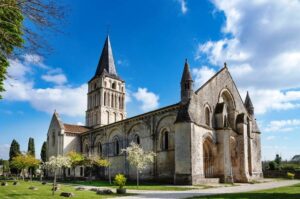
Next, 19 kms away is Aulnay-de-Saintonge, known for its parks and the 12th century St Pierre Church, a masterpiece of Romanesque architecture, and a UNESCO World Heritage site, famous for its detailed façade and sculptures, and the remains of the Gallo-Roman town. its medieval streets and bustling Sunday market.
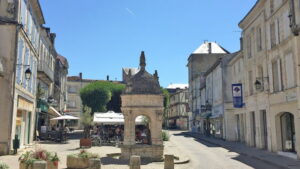
Saint-Jean-d’Angely, about 18 kms further south is a pretty, historic town known for the unfinished Royal Abbey of Saint-Jean-Baptiste, its medieval architecture—especially the imposing belfry or clock tower—and its position on the banks of the Boutonne River, a popular kayaking spot.
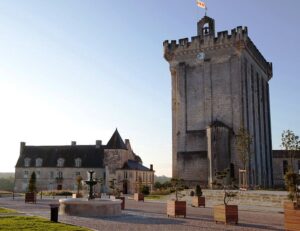
Passing on through Saintes and Pons, you will finally reach Bordeaux.
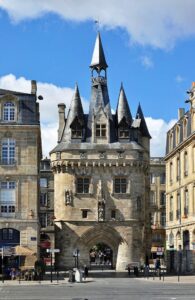
There is such a wealth of sights and things to do in this beautiful city—far too much to discuss here, so check out my blog to learn more:
https://parisplusplus.com/france/bordeaux-region/discovering-bordeaux/
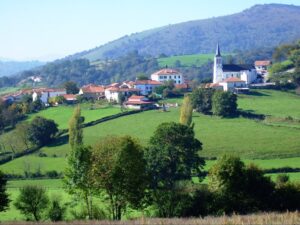
South from Bordeaux, the route passes through the vast, seemingly endless, pine forest of les Landes. The path ultimately connects to the Camino Francés (a footpath now called Grande Randonnée 65), near the tiny village of Ostabat-Asme, in an idyllic location in the department of the Pyrénées-Atlantiques.
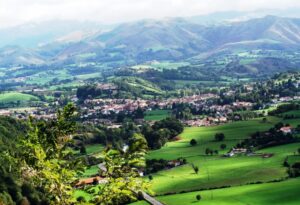
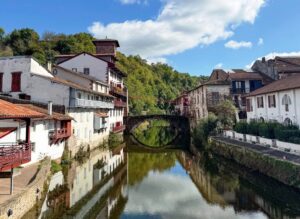
From here, it’s only 17kms to Saint-Jean-Pied-de-Port, located on the river Neve, and at the foot of an important pass through the Pyrenees between France and Spain. The old capital of the traditional Basque province of Lower Navarre, it is a beautiful, unspoiled village surrounded by a brilliant green landscape, which beckons not only keen hikers, but those seeking relaxation, strolling through the cobbled streets, and stunning walks through the nearby hills, many of which are covered in terraced vines.
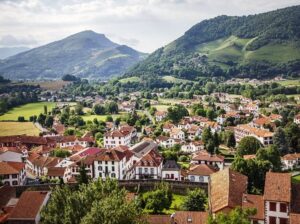
The town was founded during the 12th century, and was part of the Kingdom of Navarre. Overlooking the town at an altitude of 80m, the most important monument of the town is its citadel built on the ruins of an ancient, fortified castle and redesigned by Vauban in 1685. The defensive walls around the town have remained largely intact. Only 50 kms from the Basque coast, and the Spanish border is only 10 mins. away. This small town becomes quite busy with pilgrims and general visitors, so it’s wise to have accommodation booked here before you arrive. The town is where several European pilgrimage routes converge before heading into Spain and on to Santiago de Compostela.
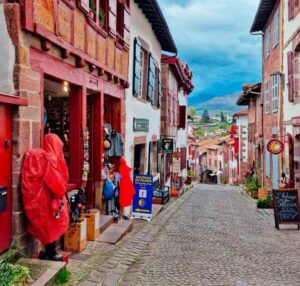
The Pilgrim Office is at no. 39, rue de la Citadelle. This office issues pilgrims with their ‘credencial’, an accordion-fold booklet which is your passport to the camino and a required document in most pilgrim-specific accommodation. It also earns you pilgrim prices in many museums and will serve as proof of your journey when presented to the Pilgrims Office in Santiago if you are planning on getting your Compostela Certificate. They also issue weather reports for the mountain pass, advice about accommodation, and anything else you need to ask to prepare you for your onward journey, such as weather reports and suchlike.
We will explore other routes from France to Saint-Jean-Pied-du-Port in future stories.
Leave a Reply