

THE STUNNING MEDIEVAL CLIFFSIDE VILLAGE OF ROCAMADOUR
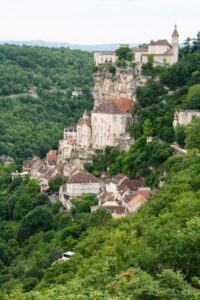
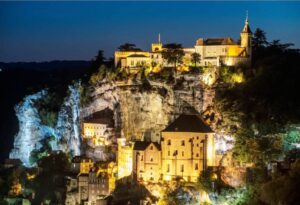
The village of Rocamadour, in the department of the Lot, would have to be one of the most spectacular sites in the country. Even those that have not been there recognise it immediately in photographs. Rocamadour has rightly been described as having vertical architecture, and is a tribute to the ingenuity of the early generations who constructed it. Needless to say, it is a member of the Plus Beaux Villages de France group, and importantly, is a listed UNESCO World Heritage Site.
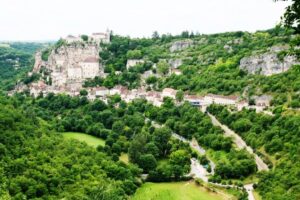
Rocamadour is in a wonderful location for exploring so many parts of France. In the department of the Lot, it’s in the far north of the Occitanie region, close to Perigord and the Dordogne valley, it is at the heart of the Parc Naturel Régional des Causses du Quercy, a regional nature park. It’s also only 36 km N.E. of Cahors by road and about 163 kms north of Toulouse, which is also the nearest railway station. As you can see, it’s easy to plan a trip through many of the country’s most beautiful destinations.
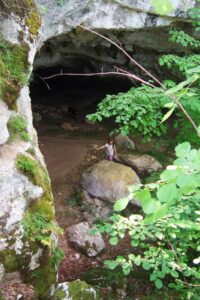
Rocamadour and its many caves housed people in the Paleolithic era, as is evidenced by the cave drawings of the Grotte des Merveilles, just 2 kms from the village—see further info. below. The Grotte de Linares cave served as an underground necropolis and a habitat during the Bronze Age. Today, houses, churches and other buildings all look as though they’re part of the same rocky cliff face.
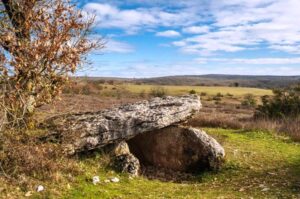
During the Iron Age, in the 8th century BCE, the Cadurques people arrived from Germany, colonised the Lot region and introduced iron weapons. An oppidum (fortified settlement) has been identified perched on the heights of the Alzou valley, which is a short tributary of the Dordogne, that archaeologists think was perhaps linked to the battle of the Gauls against the Roman invading troops of Julius Caesar during the Gallic War, between 58 and 50 BCE.
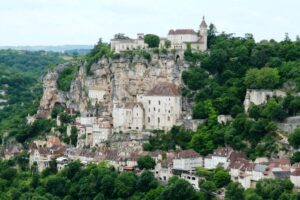
The three levels of Rocamadour that we see today date from the Middle Ages and reflect the strata of medieval society: the knights above, religious clerics in the middle level, and the lay workers on the lowest level, down near the river.
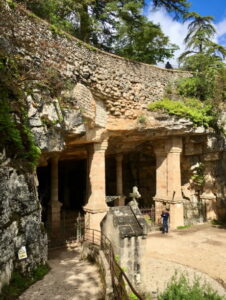
There is written evidence that in 1105 a small chapel was built in a shelter of the cliff at a place called Rupis Amatoris, what was the limit of the territories of the Benedictine abbeys of Saint Martin at Tulle, and Saint Pierre at Marcilhac-sur-Célé. In 1112, an Abbot of Tulle settled in Rocamadour, and a few years later, a donation was made by the local Comte de la Marche. In 1148, the first miracle attributed to the Virgin Mary was announced, resulting in a considerable increase in the number of pilgrims. Knowledge of the miracles resulted in Rocamadour becoming one of the four pillars of Christendom in the Middle Ages, on a par with Jerusalem and Rome, and became one of the destinations on the pilgrimage route to Santiago di Compostela.
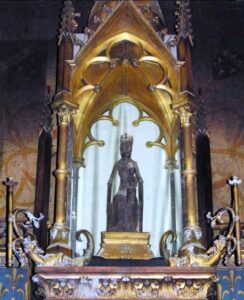
It seems though, that according to the Livre des Miracles, written by a monk from the sanctuary in the 12th century, Rocamadour had already become famous as a place of pilgrimage. In 1159, Henry ll of England, husband of Eleanor of Aquitaine, came to Rocamadour to thank the Virgin for healing him. The statue of the Black Madonna dates from the 12th century. Geraud d’Escorailles, who was abbot from 1152 to 1188, built the religious buildings, financed by donations from pilgrims.
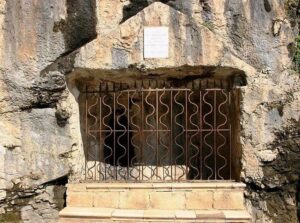
In 1166, during the excavation for a grave in front of the entrance to the chapel of the Virgin, an intact body was unearthed, presented as that of Saint Amadour, a hermit who was credited with being the founder of the shrine of Our Lady of Rocamadour. Rocamadour had found its saint.
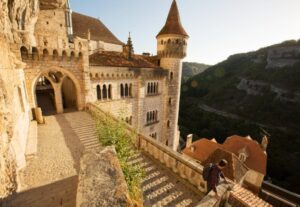
In 1211, during the Albigensian Crusade, the pontifical legate spent the winter in Rocamadour, and in 1291, Pope Nicholas IV granted 3 bulls (papal decrees) and 40 day indulgences for site visitors. The end of the 12th century saw the end of Rocamadour’s influence, and the completion of the buildings. The castle was protected by 3 towers, a wide moat and numerous lookouts. In 1317, the monks left Rocamadour, and the site was administered by a chapter of canons appointed by the bishop. However, in the 14th century, a cooling climate, famines, epidemics such as the Black Death, ravaged Europe. Some reconstruction was started in 1427, but without financial or human resources. A huge rock crushed the chapel of Notre Dame, which was rebuilt in 1479 by the Bishop of Rulle.
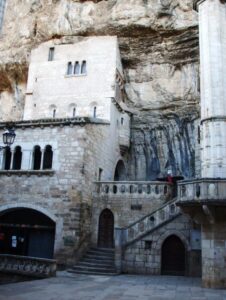
During the Wars of Religion, the iconoclastic passage of Protestant mercenaries in 1562 caused the destruction of the religious buildings and the relics, including the body of Saint Amadour. Contemporary witnesses testified that they saw the Protestant Captain smash it with a blacksmith’s hammer. The treasury of Notre Dame was looted and sent to the Prince de Condé’s army. The site was again looted during the Revolution.
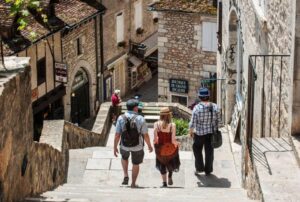
There are 216 steps that make up the so-called Great Staircase, separating the lower town from the complex of religious buildings that are halfway up the cliff. In past centuries, pilgrims would do the 216 step climb to the Sanctuary on their knees. Thankfully, these days visitors can take one of the two elevators that link the lower town to the upper level if the idea of so many stairs is too daunting!
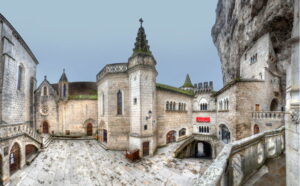
The Sanctuary is made up of 7 chapels that seem to overlay each other, built around a courtyard, the Parvis des Églises. The Chapelle Notre Dame and Vierge Noire (Black Madonna) statue are perhaps, for many, the highlight of a visit to Rocamadour.
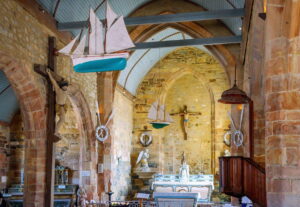
The small figure of the Black Madonna was carved from the timber of a walnut tree in the 12th century, and has drawn pilgrims from all over Europe in search of miracles. Overhead, the 9th century iron bell is said to ring on its own when somewhere in the world the Virgin performs a miracle. Many such miracles are linked to sailors in peril at sea, hence the model boats hanging from the ceiling.
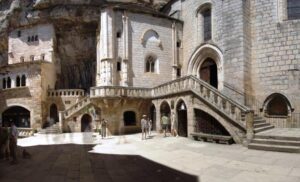
Back against the cliffs next to the chapel lies the UNESCO-listed 850 year old Basilique Saint-Sauveur, the largest building in the Sanctuary, built in the Romanesque-Gothic style. The crypt of Saint-Amadour is just below the basilica.
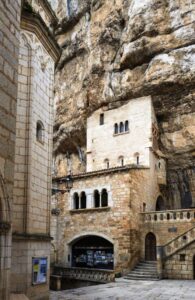
The highest of all the religious buildings in Rocamadour is the Chapelle Saint-Michel. It has no roof nor a western wall, as the chapel was carved into the rock. Medieval pilgrims did not have access to the chapel, as it was strictly for the use of the Benedictine monks. The fact that it was built under a rock overhang has allowed the chapel’s 13th century frescoes to survive in an exceptional condition. On the lower part of the wall is half of a now-faded fresco depicting St Christopher, whilst above is a representation of ‘The Annunciation and the Visitation’. There are more frescoes inside.
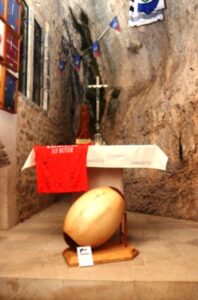
The Chapelle Saint-Louis et Notre Dame de l’Ovalie is built into the cliff, and was originally dedicated to King Louis, who travelled to Rocamadour as a pilgrim in May 1244. However, interestingly, since 2011 the chapel has been re-dedicated to rugby players, and prayers are now said there for those injured during a game. Consequently, the chapel has on display the shirts of many famous rugby players from all over the world.
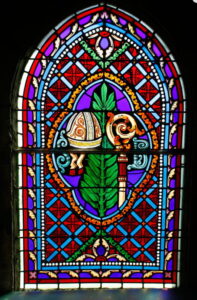
The Chapelle Saint-Blaise is dedicated to a 4th century physician who was martyred by being tortured and beheaded. It is a small chapel, but has particularly beautiful stained-glass windows. It’s in a strategic position in the Sanctuary precinct, as the west window is above the Grand Escalier. This enabled it to be used as a surveillance point during the Hundred Years’ War as part of the Sanctuary’s defensive system.
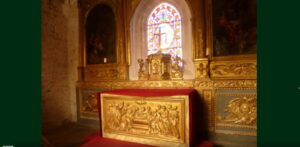
Another chapel worth a visit is the Chapelle Sainte-Anne, which was built in the 13th century. It contains a 17th century altarpiece which was moved from Chapelle Notre-Dame. A stained-glass window is from the 19th century, and depicts the Virgin as a young girl with her parents, Sainte Anne and Saint Joachim, and the dove of the Holy Spirit. On the walls of the chapel are photographs of engravings showing the ruins of the Sanctuary after the Revolution.
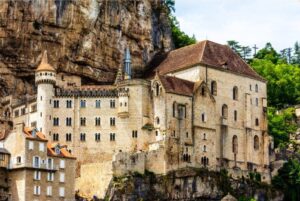
The Parvis (square) leads to the Palace of the Bishops, restored in the 19th century. It’s now a Museum of Sacred Art and exhibits regional religious art as well as special loans from churches around the world.
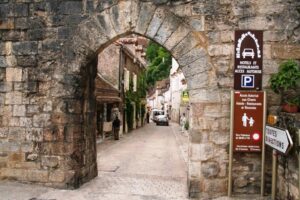
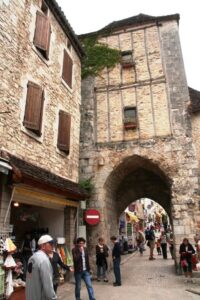
Coming into the town from the lowest level, you enter Rocamadour through the Porte du Figuier, then follow the rue de la Couronnerie. This is the main street of the village, very pleasant, lively and full of shops, restaurants, hotels and residences. In the Middle Ages, this narrow strip of road would have been crowded with pilgrims. There would have been a support system including mills, hospitals and defence gates for this holy site.
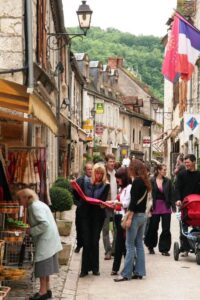
Much of the village along this main artery remains unchanged in layout, although there has been restoration work to the facades that have eroded over time. From this elevation and straining to look upwards at the churches and the castle far above, one can appreciate how the majestic power of architecture and height must have persuaded the medieval pilgrims of the stories of miracles associated with the site.
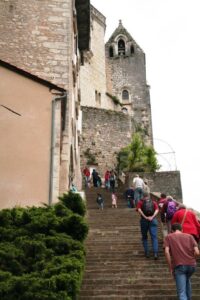
You will then arrive at the monumental staircase, where at the top you will reach the square—the Parvis–where the churches and chapels cling to the rock face. Alternatively, as mentioned, take the elevator up to this level.
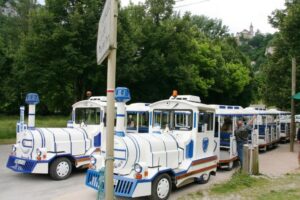
After visiting the Sanctuary level, in order to reach the top of the cliff 70 m. above to visit the chateau, there are a number of options. The easiest way is to take the Ascenseur Incliné (inclined lift) from the Sanctuary level. Alternatively, you can walk up the steep Chemin de Croix (Way of the Cross) pathway, take the little tourist train, or drive directly to the P2 parking lot at the summit.
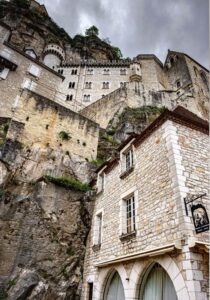
The original fortifications date back to the 12th century, when Rocamadour was a thriving settlement and pilgrimage centre. The castle served as a defensive bulwark against potential invaders. During the Hundred Years’ War, it was instrumental in safeguarding both the Sanctuary and the town.
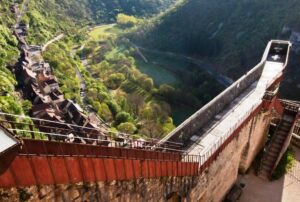
As well as being a residence, the castle comprised ramparts and a garrison housed in a fortified dwelling, rather than a typical château. An 8m wide moat provided additional defence, while a secret staircase linked the inner courtyard to the Sanctuary below, allowing for rapid movement of troops in times of siege or attack.
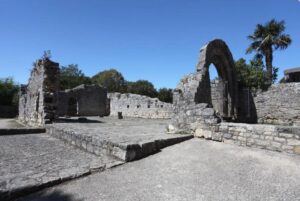
However, the castle declined in the centuries following the Middle Ages. Although it was heavily in use during the Wars of Religion, it fell into disrepair during the Renaissance. By the 17th century, it had been largely abandoned, and by the time of the Revolution, its once-imposing ramparts were in ruins.
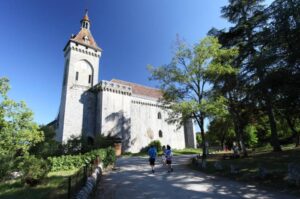
The castle had a revival in the 19th century, thanks to a Parisian priest, Abbé Caillau. He came to Rocamadour to pray before the Black Madonna when he was suffering from a serious illness. He experienced a miraculous recovery, and in gratitude, purchased the ruined fortress castle at an auction in 1836. By 1841, the castle had been renovated and became the residence of the Sanctuary’s chaplains.
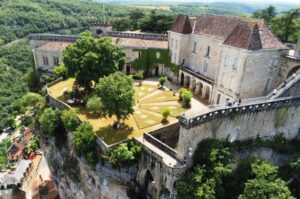
What we see today is a combination of medieval and 19th century architecture. Built against the remnants of the original fortifications, the castle is flanked by a bell tower equipped with a carillon, and the structure is in the region’s characteristic style. Much of the castle is in a state of some disrepair, so that the ramparts are the only part accessible to visitors, for a modest fee of 2 Euros. Walking along the ramparts, visitors can see the outlines of the original fortifications and imagine the strategic considerations that shaped their construction, as well as the ingenuity and resilience of those who built and those who sought protection for the village and revered Sanctuary. Needless to say, there is an incredible 360 deg. panoramic view of the Alzou Valley and the surrounding countryside, which alone make the effort of reaching the ramparts such an unforgettable experience.
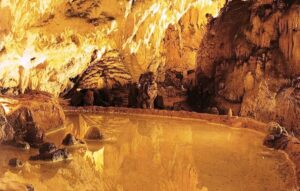
Just near the L’Hospitalet parking area and not far from the Tourist Office in town is the Grotte des Merveilles, which is a small, prehistoric cave discovered in 1920 that features authentic Paleolithic cave paintings dating back over 20,000 years. These are hand stencils and depictions of horses, stags and bears. It is also noted for its beautiful stalactites, stalagmites, crystalline basins and calcified pillars. Classified as a Historic Monument in 1925, this is one of the few original caves in the region open to the public, showing both natural geological formations and prehistoric art. Tours are guided, and take approx. 45 mins. and available from April to November.
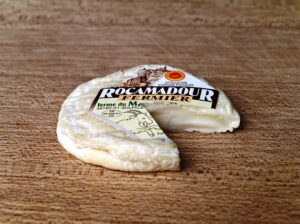
cheese.
As well as the remarkable town itself, there are other delights to experience, such as the local goats’ milk cheese, originally called ‘Cabécou de Rocamadour’ in the 15th century, now just known as ‘Rocamadour’, it’s irresistible when thickly spread on lightly toasted bread, and in salads with walnuts.
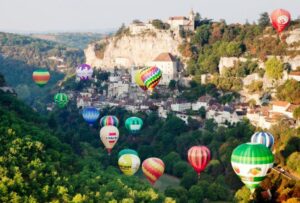
If you are planning a visit in September, there is a fabulous spectacle of the Montgolfiades of Rocamadour, a two-day festival of hot-air ballooning on the last Saturday and Sunday of the month. It’s cost free, but of course very popular, so go early to secure a parking place. Consider making a reservation at one of the local on-site restaurants for a delightful dining experience amid this breathtaking spectacle.
Rocamadour is such an unforgettable experience, and surrounded by the beautiful countryside of the Dordogne Valley, it’s a Must See if you’re planning a trip to this part of the country. It’s also just a 3 hr. drive from Bordeaux and within reach of Toulouse.
Leave a Reply