

THE MAGNIFICENT FORTIFIED CITY OF CARCASSONNE
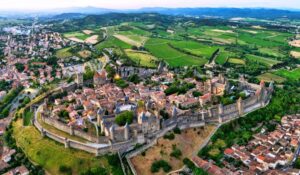
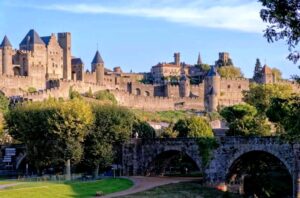
The spectacular fortress of Carcassonne is regarded as the best-preserved medieval fortress in Europe, and according to many experts, the world, and has been the inspiration for countless castles that have been invented in fairy tales. Carcassonne is located in the Department of the Aude in the Occitanie region of southern France, a 3-hour drive from the Pyrenees and only 150 kms from the Spanish border. To the northwest, it’s about 80 kms from Toulouse. The city boasts splendid ramparts with watchtowers, a portcullis, a drawbridge and elevated defences built on top of a hill. All of this, together with its almost 2,000 years of history, it’s easy to see why this World Heritage site is one of the biggest drawcards in the country.
The area in and around Carcassonne is known to have been inhabited since the Neolithic period. Located in the plain of the Aude between historic trade routes linking the Atlantic to the Mediterranean sea, and the Massif Central to the Pyrenees. The hilltop was an important trading place by the 6th century BCE for a Gallic tribe called the Volcae, who fortified it and made it into an oppidum (a hill fort), and named it “Carac.” Its strategic importance was quickly recognised by the invading Romans who fortified it around 100 BCE, and occupied it until the demise of the Western Roman Empire. The main part of the lower courses of the northern ramparts date from Gallo-Roman times.
In the 5th century CE, the wider region was taken over from the Iberians by the Visigoths. They founded the city of Carcassonne in the newly established Visigothic Kingdom, which stretched from southwestern Gaul and south into the Iberian Peninsula. The Romans officially ceded the fortress settlement to the Visigothic king Theodoric ll, who had actually held Carcassonne since 453 CE.
The inner rampart was built in 485 CE, when Euric was king of the Visigoths. The Frankish king Clovis failed to take it in 508, though Muslim Arab and Berber invaders succeeded in 720. They retreated to Andalusia after 40 years of occupation after being defeated by the Christian Franks and the Carolingian king Pepin lll le Bref (the Short), who succeeded in taking over the fortress in 752.
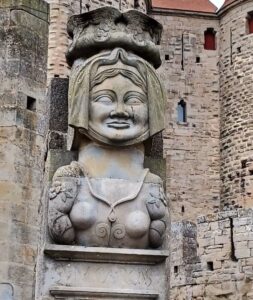
Over the Porte Narbonnaise there is a somewhat grotesque sculpture of Lady Carcas, a Saracen princess who is said to have ruled the city after her husband died during a fight with the Franks. She is credited with having fended off Pepin lll le Bref from invading the city, at least for a while.
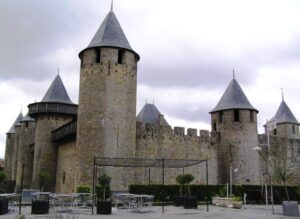
In 1067 Carcassonne became the property of Raimond-Bernard Trencavel, viscount of Albi and Nîmes, whose descendants built the Château Comtal and the Basilica of Saints Nazarius and Celsus. In 1096, Pope Urban ll blessed the foundation stones of the new cathedral.
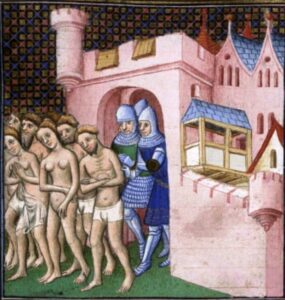
Carcassonne became famous for its role in the Albigensian Crusades when the city was a stronghold of the Cathars. This somewhat obscure Christian faith was denounced by the Catholic Church as heretical, and in 1209 the followers of Cathar doctrine were attacked first by the Albigensian Crusaders led by the Papal Legate, who expelled the people of Carcassonne with nothing more than the shirts on their backs. Simon de Montfort was appointed the new viscount and added to the town’s fortifications.

The city submitted to the rule of the kingdom of France in 1247 and became a border fortress between France and the Crown of Aragon. King Louis lX and his successors built the outer ramparts, and the fortress town was considered to be impregnable. During the Hundred Years’ War, Edward the Black Prince failed to take the city in 1355, although his troops destroyed the lower town.
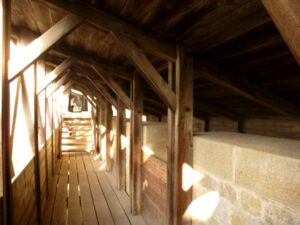
It’s known that during sieges, temporary wooden platforms and walls would be fitted to the upper walls of the fortress through square holes in the face of the encircling wall. These provided protection to defenders on the wall, and also allowing defenders to go out past the wall to drop projectiles on attackers at the wall’s outside base. However, the fortifications were not designed to withstand a specific siege—although it was never taken by force—the main objective was to protect a city built on a strategic site and was on an important trade route.
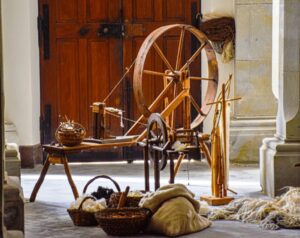
In 1659, the Treaty of the Pyrenees transferred the border province of Roussillon to France, and Carcassonne’s military significance was reduced. Its fortifications were abandoned, and the city became an economic centre of the woollen textile industry, and became known as “the manufacturing centre of Languedoc.” It remained as such until the Ottoman market collapsed at the end of the 18th century, and the once-thriving city became a quiet country town. Today, you can visit the Maison de la Maison de la Laine et du Drap (Museum of Wool and Textiles) in Carcassonne.
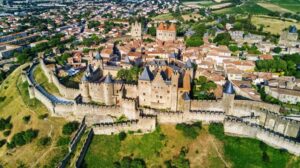
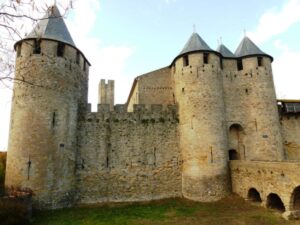
The fortified city consists essentially of a concentric design of two outer walls with 52 towers and fortified gateways, known as barbicans, to prevent attack by siege engines. The castle itself had a drawbridge and ditch, leading to a central keep. The walls and towers were built over quite a long time period. One section of the wall is Roman, and is notably different from the medieval walls. One of these later towers housed the Inquisition in the 13th century, and is still known as The Inquisition Tower.
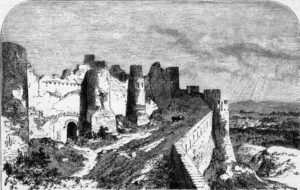
Carcassonne was demilitarised under Napoleon Bonaparte and the Restoration, and the fortified city fell into such disrepair that the French government decided that it should be demolished, and the decree to that effect was officially made in 1849. That caused such an uproar that the mayor of Carcassonne and the writer Prosper Mérimée, the country’s first inspector of ancient monuments, led a campaign to preserve the fortress as a historic monument.
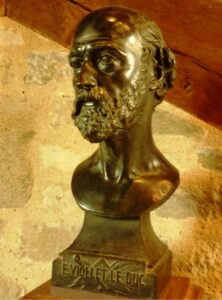
Later that year, the architect Eugène Viollet-le-Duc, who was already working on the restoration of the Basilica of Saints Nazarius and Celsus, was commissioned to renovate the whole site. He had already taken charge of the restoration of Mont Saint Michel in Normandy, Notre Dame in Paris and the great basilica of Vézelay in Burgundy. Aside from some criticism at the time for Viollet-le-Duc’s choice of some materials used in the restoration work, what we see today is the city of his restoration.

As well as the city itself, Viollet-le-Duc restored the Porte d’Aude, dating from the time of the Visigoths, and also embellished the Porte de Narbonne by adding the drawbridge, which did not exist before. This is now the main entrance into the city. Carcassonne was declared a World Heritage Site in 1997.
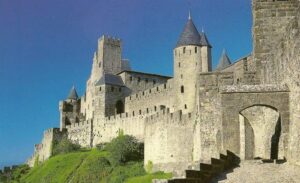
Visiting the city is easy. Its gates are open, as entry is free, so it’s simply a matter of strolling through the cobbled streets into the heart of the city. Note though that there is a fee for the nearby car parks. There’s also a fee to visit the ramparts and the château. Be sure to pick up a map of the fortress from one of the 3 information points to find your way around the streets more easily.
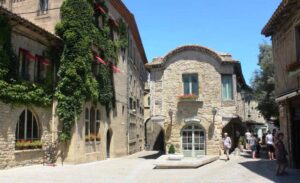
Throughout the town, although there are a few decent shops, you will certainly encounter some somewhat tacky souvenir shops and suchlike, but just ignore all that, and concentrate on the historic sights—which is why you’re there!
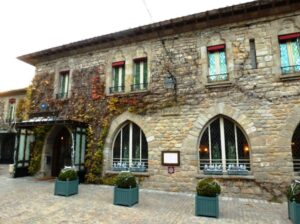
Regarding accommodation, there’s a number of hotels outside the ancient city in the town below, but last time we were in Carcassonne, we found a small hotel inside the ancient city. It turned out to be a lovely thing to do, as once the daily crowds depart, it’s quiet and a delight to wander around in the evening light.
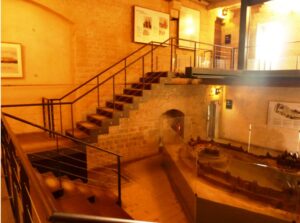
Visit Château Comtal, originally the home of the powerful feudal lords. This huge medieval fortress and its enclosure have 9 towers, including the square Pinte watchtower, the highest in the city. It is truly the “fortress in the fortress”. The château has a well-presented, one-way walking route through the keep and up onto the ramparts, which consist of a double enclosure, part of which dates back to the Gallo-Roman era. The interior is also very interesting. You can admire the finely frescoed ceilings and a large collection of Gothic and Romanesque artefacts. The tallest tower in the entire fortification is the mighty Cour du Midi.
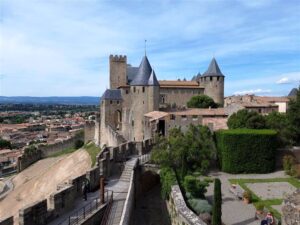
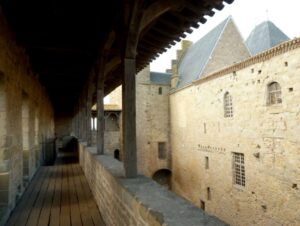
After an extensive renovation and restoration in 2024, visitors can now take a complete tour of the ramparts. Nine towers were also restored, allowing this emblematic part of the medieval town to be accessible for the first time. Now, visitors can travel almost 1.5 kms independently on the inner enclosure, with the possibility of accessing intermediate exits for those who prefer to do only part of the route.
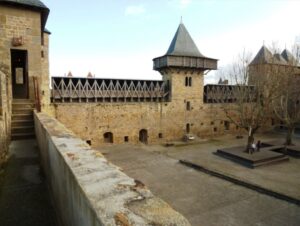
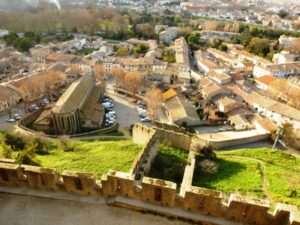
A walk along the ramparts offers breathtaking 360 deg. views of the city, from the castle over the canal du Midi and surrounding landscapes, from the foothills of the Pyrenees to the Massif.
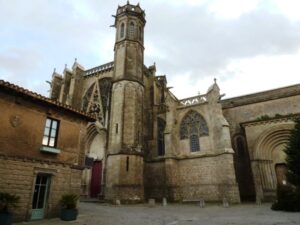
At the southern end of the old city, The Basilica of Saint Nazaire is located near the Porte d’Aude. Built between 9th and 14th centuries, it was the cathedral of Carcassonne until 1801, when it was then replaced by the cathedral of Saint-Michel over in the Bastide Saint Louis. The stained glass windows, depicting scenes from the life of Christ and the apostles, are considered the most beautiful in the south of France.
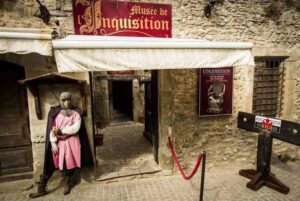
There are a number of small museums in the town, which tell the story of the town’s life, such as the school museum, which has several reconstructions of old classrooms that explore what school life was like in France between the 1800s and 1960s. The Museum of the Inquisition traces the history of this dark period and showcases torture tools ranging from the 12th century up to the French Revolution that were used on heretics, Cathars or alleged witches. You can visit the dungeons and the different displays, observing the trials reserved for heretics, from their trial through to their torture, burning at the stake or other methods of killing. Not for the faint-hearted!
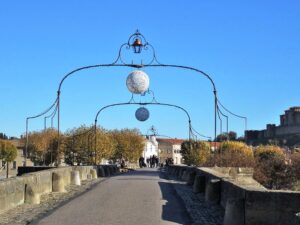
Most visitors to Carcassonne go to the ancient citadel, spend a few hours exploring, walking around the ramparts, and leave. However, if that’s the extent of your visit, and you don’t cross the Pont Vieux at the base of the ramparts and visit the Bastide Saint-Louis, you are really missing out. Worth a visit in its own right, this medieval district of Carcassonne is a little gem that often gets overlooked, thanks to its more famous neighbour. This is a great shame, especially since it’s just a 10 min. walk from the ramparts.
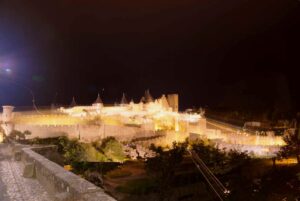
In 1260, a new Carcassonne, called the Bastide Saint-Louis, was created at the base of the hill of the ancient citadel, built on the left bank of the river Aude. Focussed on reaching the ancient citadel, many visitors don’t even notice the imposing gates across the Pont Vieux (old bridge) to this fascinating area that’s rich in history, architecture, cafés and restaurants, shops and markets. The Pont Vieux is a spot that gets packed at night with photographers attempting to capture the beauty of the citadel when it’s lit up against a starry sky. Built in the 14th century, the bridge was the only link between the two towns until the 19th century.
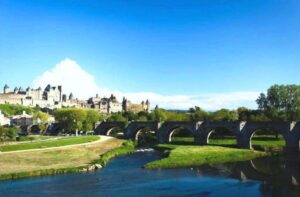
On the other side of the Bastide lies the Canal du Midi, gently winding its way through the countryside. You can take a boat ride for an hour with Bateau le Cocagne, near the railway station.
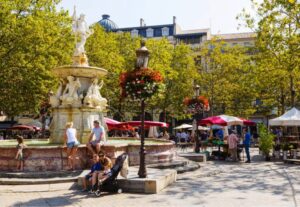 Inside the Bastide is a warren of streets lined with historic buildings. The town spreads outwards from the central square, Place Carnot, with its famous fountain, loved by the great French writer, Balzac. This square is the perfect setting to relax at a terraced café and watch the world go by. Where the ancient moats once were, there are now boulevards lined with houses and shops. One thing you are sure to notice is that the pavement is made from rose coloured marble. This was laid to honour the visit of Louis XIV, the Sun King. The marble was quarried from nearby Caunes, Minervois. Marble from this quarry was also used at Versailles, the Opera Garnier in Paris as well as the White House in Washington.
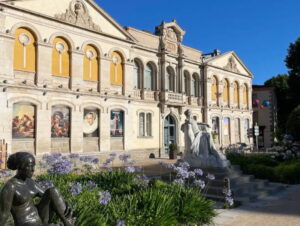
The Bastide has many magnificent mansions that date back to the 17th and 18th centuries, when the city was home to prosperous merchants. Many made their fortunes from the textile manufacturing industry that Carcassonne was famous for.
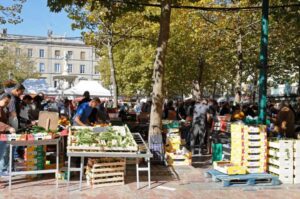
Try and plan a visit for a Tuesday, Thursday or Saturday, when the weekly outdoor market takes place, as it has done for centuries. It’s a vibrant, buzzing market and plenty of delicious smells scent the air. From Monday to Saturday there is also a covered market at Les Halles.
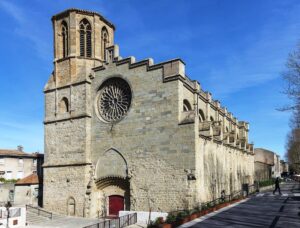
There are several churches from the 13th and 14th centuries, but the 14th century Cathedral of Saint-Michel is special. While cathedrals of these eras had painted interiors, most of them have faded over time, but this church is an exception. It was closed in the 16th century and left like that for years, so amazingly, its paintwork still looks bright and fresh.
There is a lot to see in this location. Not just the ancient citadel—certainly the main attraction—but do leave time to visit the Bastide. It will add so much more to your visit. Be aware though that Carcassonne is a very popular site, and you will certainly encounter lots of other visitors at most times of the year. You can reach Carcassonne by train from Paris, which takes a little over 5 hours, or there is Carcassonne Airport that has a shuttle service to the city centre.
Leave a Reply