

DISCOVER THE RICH HISTORY AND TREASURES OF BEAUVAIS
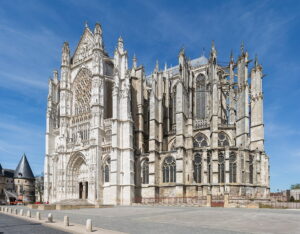
There are many treasures to discover in Beauvais, most notably its Cathedral–Cathédrale Saint-Pierre–which is one of the most outstanding Gothic cathedrals in the country. Built around 1247, its vast height is breathtaking at over 46m, making it the tallest cathedral in Europe. It’s also famous for its elaborate astronomical clock, exquisite stained glass windows, and magnificent tapestries from the 15th and 17th centuries. The town itself, including the beautiful Hotel de Ville and the episcopal palace, make a visit to Beauvais well worthwhile. So go and discover why, in 2012 the town was awarded the prestigious accolade of “Ville d’Art et d’Histoire” by the French Ministry of Culture.
At less than 84 kms from Paris, the city of Beauvais can easily be visited for a day trip, with trains running about every half hr. and an average journey time of around 1 hr. 15-30mins., and about the same by car using the motorway. A city with more than two millennia of history, at the heart of which stands the highest Gothic choir in the world, several millennia of ceramic tradition, and home to a tapestry factory for more than 350 years, a city twice awarded the “fleur d’or” (“golden flower”) for its gardens, Beauvais boasts a heritage of great variety, whether built, intangible or natural.
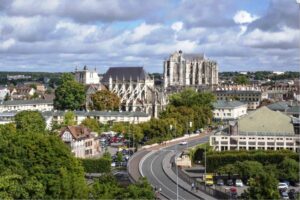
Beauvais lies at the foot of forested hills on the left bank of the Thérain, at its confluence with the river Avelon. Its ancient ramparts have long gone, and the town is now surrounded by boulevards, with branches of the Thérain just outside. The N.E of the town has pleasant, spacious promenades to enjoy.
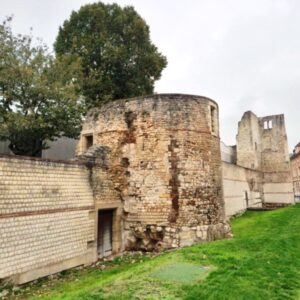
Beauvais was known to the Romans by the Gallo-Roman name of Caesarromagus, and it was the capital of a Belgic tribe called the Bellovaci when Julius Caesar and his forces invaded. Caesar’s ‘De Bello Gallico’ (Gallic Wars) reports that as Caesar was approaching the fortified town, its inhabitants surrendered to him when he was about 5 Roman miles away.
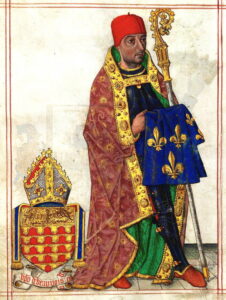
It later became a county (comté), and about 1013 passed to the bishops of Beauvais, who became peers of France from the 12th century. At the coronations of French kings, the Bishop of Beauvais wore the royal mantle and went, with the Bishop of Langres, to raise the king from his throne to present him to the people.
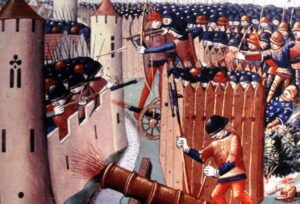
Beauvais was subject to numerous attempts to besiege it. In 1346, the town had to defend itself against the English, who again besieged it in 1433. In 1472 the Duke of Burgundy, known as Charles the Bold, laid siege to the town, and this event has gone down in history for the heroism of the town’s women, under the leadership of one Jeanne Hachette—whose memory is celebrated in an annual parade on 27 June, during which the town’s women take precedence over the men.
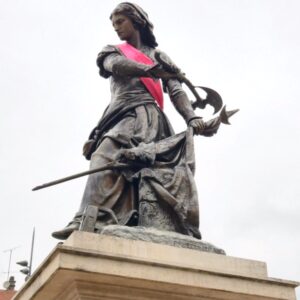
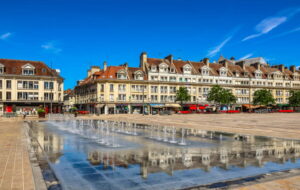
In front of the Hotel de Ville a statue depicting Jeanne Hachette was unveiled in front of it in the presence of the President of France, Louis Napoleon Bonaparte on 05 July 1851. Today, Place Jeanne-Hachette is the heart of city life. It’s surrounded by shops, cafés and brasseries, and is the location of markets and public events.
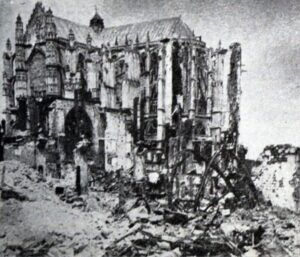
Beauvais was extensively damaged during WWl and again in WWll during the German advance on Paris in June 1940. Much of the older part of the city was all but destroyed, and the cathedral suffered considerable damage before being liberated by British forces on 30 August 1944.
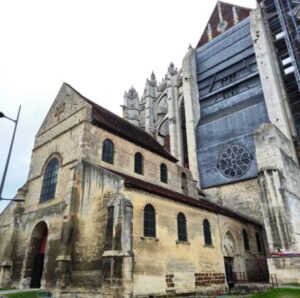
The town’s main claim to fame is the Cathédrale Saint-Pierre de Beauvais, regarded as one of the most daring achievements of Gothic architecture in Europe. It consists of a transept and choir, with apse and seven apse-chapels. The height of the vaulted ceiling exceeds 46m in height. Remnants of the original, small 10th century Romanesque church, known as the Basse Oeuvre, occupy the site of the unbuilt nave, although much of its east end was demolished to make room for the new cathedral. The building only consists of its choir and transept.
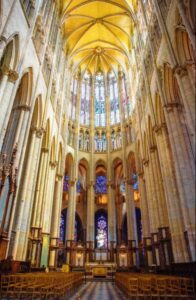
Construction was begun in 1247, and under Bishop Guillaume de Gres an extra 5m were added to the height, to make it the tallest cathedral in Europe. However, in 1284, the building work was interrupted by the collapse of the vaulting of the choir, which unnerved the masons working in the new Gothic style, halting the construction work for a few years. The transept was built from 1500 to 1548. However, the collapse of a too-ambitious central tower stopped work again, after which little addition was made to the structure.
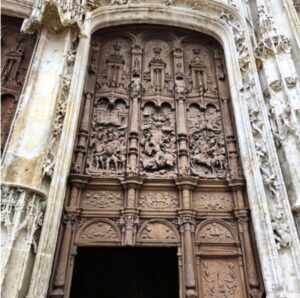
The façades of the cathedral are the epitome of the richness of the late Gothic period. The carved timber doors of both the north and south portals are masterpieces of Gothic (the north) and Renaissance (south) workmanship.
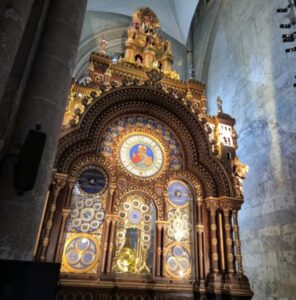
One great attraction for many visitors is a very elaborate astronomical clock with an impressive height of 12m, built in 1866, commissioned by the Bishop of Beauvais. The clock contains nearly 90,000 components and features 50 miniature figurines and planetary movements. In its lower section are 52 dials powered by motors that also ensure the functioning of the chimes. The cathedral also has a smaller astronomical clock from the 14th century, known as the Canon Music Clock, which features a carillon (musical bells), located in the Chapel of Sainte-Thérèse.
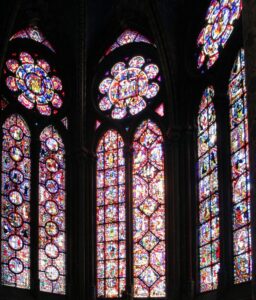
The cathedral is also home to some beautiful tapestries of the 15th and 17th centuries, and a fine collection of religious art objects. However, it’s the exquisite stained glass windows of the 13th – 16th centuries that are considered the chief artistic treasures of the cathedral, and perhaps the most beautiful of them are from the hand of the Renaissance artist, Engrand le Prince, a native of Beauvais. This man was also responsible for some of the stained glass windows in St Etienne, the second church of the town, and they are also considered to be a most interesting example of the transition stage between the Romanesque and Gothic styles.
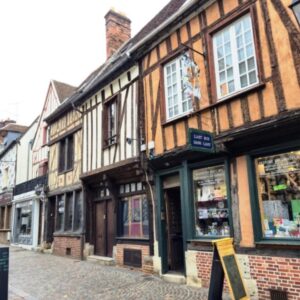
Although the cathedral is Beauvais’ main attraction, there are a number of other notable sites to visit. In the Place Hôtel de Ville and the old streets in and around the cathedral, several houses date from the 12th – 16th centuries.
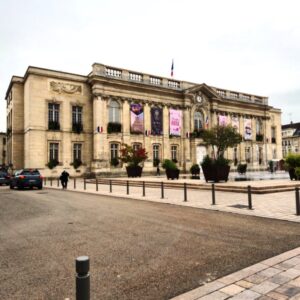
The Hotel de Ville is an impressive building, although this is not the first one for the town. That was on the Grand Place (now Place Jean-Hachette), and in 1480, the aldermen relocated to an adjacent building. Although it was rebuilt several times, it eventually became more viable to demolish it and rebuild. The foundation stone for the existing building was laid on 30 April 1753, built in the neoclassical style, and completed in 1757.
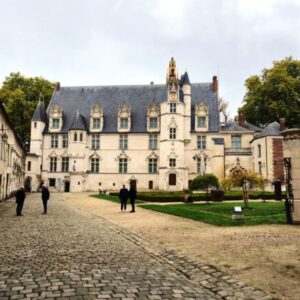
Located on one side of the cathedral is the former episcopal palace. It’s now the Musée départemental de l’Oise, which dates from the 16th century. This in turn was built partly upon the Gallo-Roman fortifications. Known to everyone as the MUDO—Musée de l’Oise—it showcases an impressive collection of paintings, sculptures and decorative arts from the Renaissance through to the 19th century. Highlights include works by Thomas Couture, Camille Corot and Alfred Sisley, plus a most interesting display of local history documents and artefacts. The building itself is worth a visit, with its grand halls, vaulted ceilings and peaceful garden courtyard.
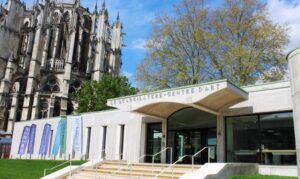
On the other side of the cathedral is a low scale, long, pale grey modern building, the Quadrilatère de Beauvais. The forecourt of the cathedral once housed the Beauvais Tapestry Manufactory until WWll when the workshops were destroyed. To pay tribute to this heritage, André Malraux, Minister of Culture at the time, launched the creation of the National Gallery of Tapestry, which was inaugurated in 1976.
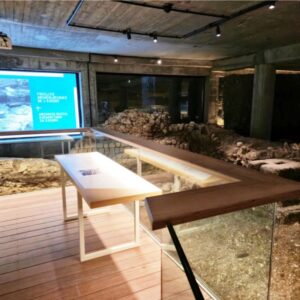
The building also provides access to remains of the Gallo-Roman walls archaeological site that extends under the cathedral, and is very much worthwhile visiting.

The tapestry exhibits of this museum highlights the evolution of tapestry-making from classical motifs to bold modern designs.
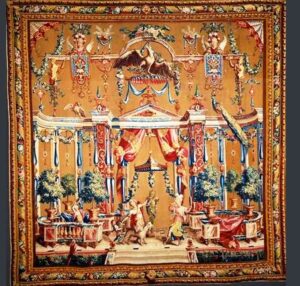
Visitors can see how the Manufacture National de Beauvais played a pivotal role in the history of decorative arts in France, and often produced pieces for royal residences. The designs of the modern tapestries are by some of the big-name contemporary artists of the 21st century. If you visit in July and August, you can watch demonstrations by weavers keeping alive the traditional techniques made famous by manufacturers such as Gobelins and Aubusson. Note that the museum is closed on Mondays. After your visit, relax in the beautifully landscaped gardens surrounding the museum.
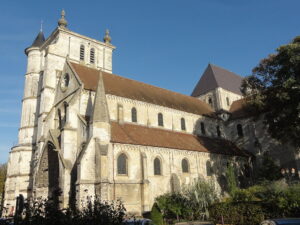
There is another important church in Beauvais, St Etienne on rue de l’Étamine, and it’s the first major church you come to if walking into town from the railway station. It was founded in the late 3rd century, although its original dedicatee is unknown, it was long dedicated to St Vaast d’Arras, with a chapter exiting under this title from 1072 – 1742. The present church dates to the 12th century, but even before this was begun, it was at the centre of medieval town life, and one of the most important parishes in the city, despite being outside the episcopal city.
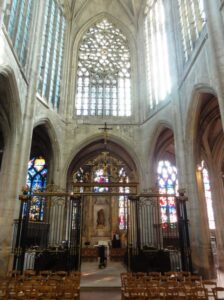
The nave and transepts are Romanesque, and excavations have shown that the Romanesque choir was demolished sometime between 1500 and 1525, to make room for a new choir in the so-called Flamboyant Gothic style, and given stained glass windows, which survived the Revolution, and are regarded as the most notable feature of the church. The choir was bombed on 8 – 9 June 1940 and was fully restored after 1945. The church was undergoing restoration to the façade when we visited recently—not before time, by the look of things!
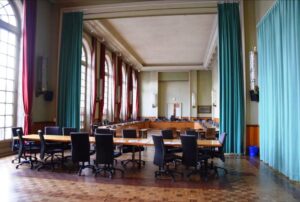
In 1918, during the later stages of WWl, Marshall Ferdinand Foch established his headquarters in the Hotel de Ville. His appointment as Supreme Allied Commander was confirmed on 03 April 1918 at a conference in the Hotel de Ville in the presence of the French Prime Minister, Georges Clemenceau, Marshal Philippe Petain, the British Prime Minister, David Lloyd George as well as Field Marshal Sir Douglas Haig, and two Americans, General Tasker H. Bliss and General John J. Pershing.

The building was badly damaged by German bombing during the Battle of France in June 1940. The façade was saved but the building itself was gutted, requiring a total rebuild internally. Today, one of the sights to see in the Hotel de Ville is the huge tapestry by Matisse, which was woven locally.
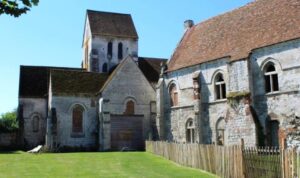
On the outskirts of Beauvais lies the Maladrerie Saint-Lazare (Leper) Hospital, a remarkably well-preserved example of medieval hospital architecture. Dating back to the 12th century, this peaceful site includes a chapel, cloister, and a great barn with timber beams some 12m high.
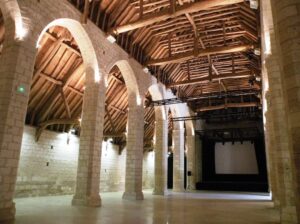
Now restored, it’s a cultural centre and event space that hosts annual music and art festivals. Its calm setting, historic ambience and contemporary medicinal garden full of aromatic herbs, cereals, berries, vines and vegetables make it a tranquil retreat from the bustle of the town.
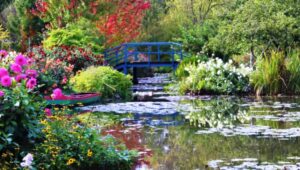
About 15 mins. by car out of Beauvais in Saint-Paul is the beautiful garden of painter Andre Van Beek. This artist, whose work is inspired by the post-Impressionist movements, opens his garden to visitors. Year after year he enriches the garden further, transforming it like a painting that’s in perpetual motion. It is indeed an open-air work of art, in a palette of colours that will delight you, in the same way as they delight and inspire the artist. You’ll see dahlias, hydrangeas, beautiful trees and ponds lined with water lilies, creating a little Giverny. You can also visit the artist’s studio.
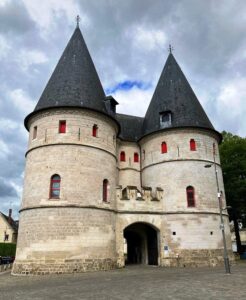
Beauvais certainly has lots to offer for a day’s outing or a weekend visit. Not only its glorious cathedral, but a charming town to explore and enjoy.
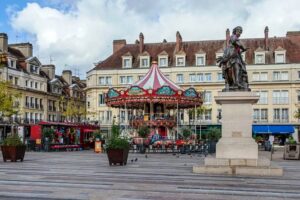
Place Jeanne Hachette, Beauvais
Leave a Reply