

AMIENS – LITTLE VENICE OF THE NORTH AND A CENTRE OF REMEMBRANCE TOURISM
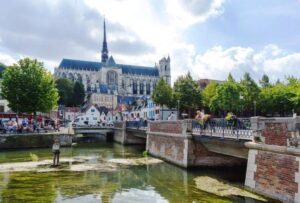
Amiens is a great destination for a weekend. Just a shade over an hour’s train ride from Paris Gare du Nord, its cobbled streets, Gothic houses and canals lined with bistros and cafes are a delight, along with numerous monuments and sites to visit. There’s a wide choice of hotels around the town, and the perfect starting off point for visiting the WWl battlefields of the Somme.
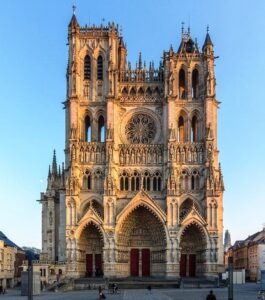
Capital of the Somme, Amiens is a small but delightful city that’s best explored on foot. Renowned for its incredible Gothic cathedral, the largest ever constructed in Europe and a World Heritage Site, Amiens is a very pleasant surprise, thanks to its charming canal districts, water gardens and lively evening atmosphere.
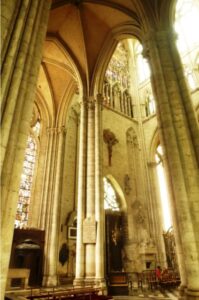
The enormous cathedral was constructed entirely between 1220 and 1270, a remarkably short period of time for a Gothic cathedral. Its style is known as Rayonnant, a very refined style of High Gothic architecture. The architects’ intention was to bring greater light into the cathedral interiors and also add more extensive decoration. They made the vertical columns and supports thinner, and made extensive use of pinnacles and mouldings as well as stained glass to achieve the desired effect.
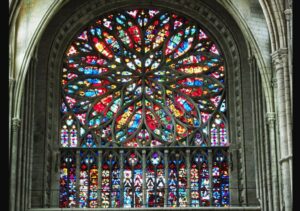
The most prominent features of the Rayonnant style were the enormous rose windows installed in the transepts and façades. The design of these windows gave the name ‘Rayonnant’ (Radiant) to the style. Other fine examples of this style are Sainte-Chapelle and Notre Dame in Paris, and the church of Sainte-Urbaine in Troyes, which were all built around the same time.
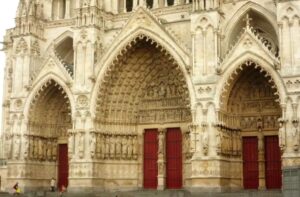
The cathedral was built to house a holy relic, the head of Saint John the Baptist, transported to France after the Crusades, and still kept inside the church. The building’s dimensions are colossal, with an internal volume of almost 200,000 sq.m., twice that of Notre Dame in Paris. It’s made up of vaults over 42m high, with an overall length of 145 m. At the entrance, 3 huge Gothic portals depict the Last Judgement, while the entire façade is decorated with scenes from the Old and New Testaments. In fact, it’s often referred to as a sort of stone Bible, narrated for a largely illiterate population through the bas-relief sculptures placed on the façade. There are more than 700 statues to contemplate: every character, imaginative, fantastical creature, 4-leaf clover, has its place and tells a story.
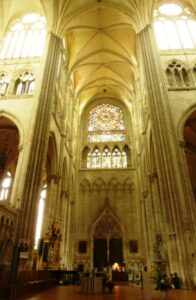
The interior is breathtaking. The majestic nave and the carved timber choir with over 4,000 figures, and the many arches and cross vaults—all of which contribute further to the Cathedral being flooded with light—give a sense of openness and upward momentum. In autumn, the soft light of the setting sun passes through the beautiful stained glass windows and spreads what seems like 1,000 colours on the stone floor of the cathedral.
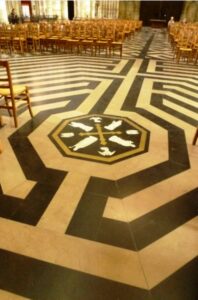
The cathedral also hides another, rather subtle, masterpiece: the octagonal labyrinth that runs along the floor of the nave. When you follow the black lines you can identify two paths, symbolising the choice humans must make. Starting on the left, this path leads towards the Light, the side associated with evil, and ends on the right, the “right” side which leads into Darkness, which starts in the west where the sun sets, i.e., the dark area, and ends in the east, the bright way of the Lord. It’s an almost unbelievable play of lines spanning an impressive total length of 234 m. Before you leave the cathedral, if you are Australian, take a look at the plaques honouring the Australian Imperial Force’s defence and participation in the 1918 Battle of Amiens.
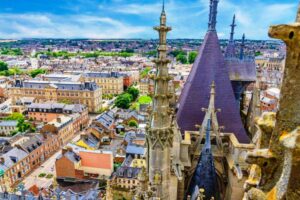
If you’re up for a bit of a climb, we can recommend heading up the steps of one of the cathedral’s towers for a wonderful panoramic view of the city. From June to Sept., just at nightfall, the façade of the cathedral becomes a magical “canvas” upon which a stunning 50 min. Son et Lumière (sound and light) show is projected.
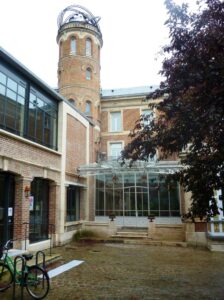
As well as the magnificent cathedral, there are a number of great sights to see in Amiens. Head to Jules Verne’s House at 2, rue Charles Dubois, a 19th century mansion that he moved into in 1882 and lived for 18 years. He was born in Nantes in 1828 and was living in Paris when he first travelled to Amiens in 1856 to attend the wedding of a friend. After falling in love with the bride’s sister, Honorine de Vianne, a young, widowed mother of 2 girls, he married her the following year and settled in Amiens. He wrote most of his ‘Extraordinary Journeys’, comprising 62 novels and 18 short stories, in Amiens.
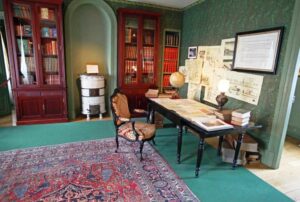
The former residence is now a house museum, with books that belonged to the author and more than 700 objects that evoke Jules Verne’s personality, sources of inspiration and related memorabilia. These objects take the visitor through the world of Phileas Fogg, Captain Nemo and other creations of Jules Verne’s imagination. The attic is full of posters and extravagant models. The Tourist Office has a map of a walking tour designed so that you follow in the author’s footsteps and find the main monuments of Amiens that marked his life there.
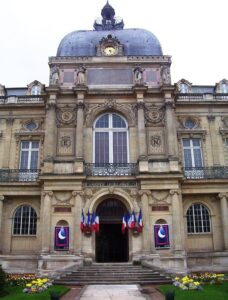
Inaugurated in 1867 under the direction of Jules Verne, the Musée de Picardie at 2 rue Puvis Chavannes, is an architectural gem, built on the model of the Louvre Museum. It houses important collections of statues, sculptures and paintings, tracing the history of art from prehistory to the present day. In addition to local artists and objects of local heritage value, there are also paintings by Tiepolo, Hals and Van Dyck as well as Picasso and Miro.
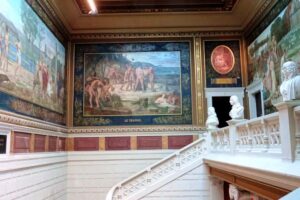
There are also large sections dedicated to Greek and Egyptian art, which house over 400 objects from the excavations in Abydos. There are also temporary exhibitions, conferences and events throughout the year.
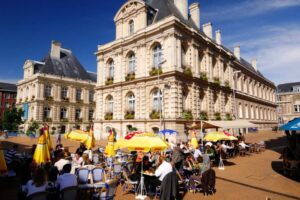
Strolling through the historic centre of Amiens will take you straight back to the Middle Ages, with its cobbled streets and Gothic houses right on the cathedral square. Note though that most of these have been rebuilt due to the significant damage done to the city during WWll, in particular from 18 to 20 May 1940, during which time Amiens was heavily bombed and about 60% of the urban building fabric was destroyed.
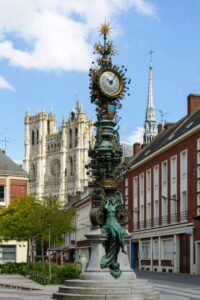
The centre nowadays is lively and very pleasant, with enticing pedestrian streets, where you can admire the magnificent Dewailly clock—a reconstruction of one that stood before 1940. It’s named after a former Mayor of Amiens who had left a legacy for a public clock to be built to enhance the city.
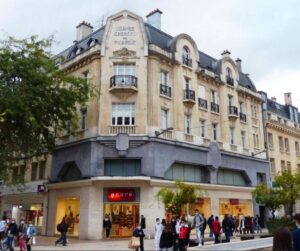
On your walk you will also see the Bell Tower and the beautiful Hotel de Ville, and then head into Place Gambetta and rue des 3 Cailloux for some retail therapy.
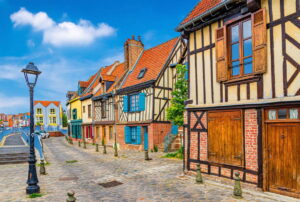
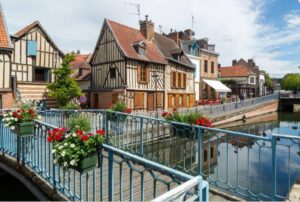
The oldest part of Amiens is not actually the centre, but if you continue your stroll you will come to the Saint-Leu district, also called the Little Venice of the North.
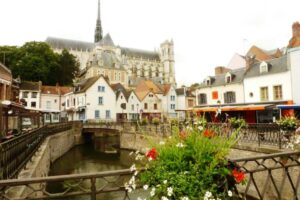
It’s criss-crossed by several canals overlooked by typical medieval colourful timber, brick and stone houses with external staircases. Here you’ll find designer boutiques, booksellers, stalls and second-hand goods traders which has totally revived this former working-class neighbourhood, where you can also enjoy theatres, concerts, shows and lively nightlife.
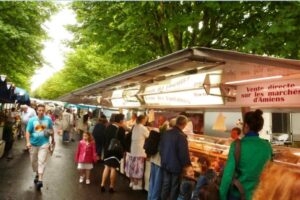
If you’re in town over a weekend, don’t miss the Saturday morning water market (or hortillonnages market), organised by local horticulturists and hortillons (traditional market gardeners), which continues a tradition in the city dating back to the early 19th century. Once a year in June, as part of the Fete dans la Ville, a market is held on the water where the horticulturists wear traditional costume and sail down the Somme in flat-bottomed boats laden with vegetables, fruit and flowers.
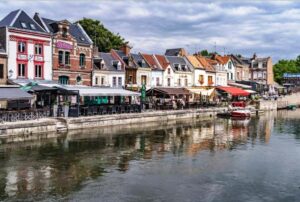
The town’s old towpath, which was once used by horses to pull boats, runs along the River Somme, and offers lovely views. It takes you from the Saint Leu quarter to the Hortillonnages, or floating gardens and waterways, that have been there since ancient times. These are made up of a multitude of small, cultivated islets surrounded by water, accessible only by boat on a network of waterways, knows as “rieux”. You will see small bridges, canals traversed by boats, houses overlooking the water and delightful corners to photograph.
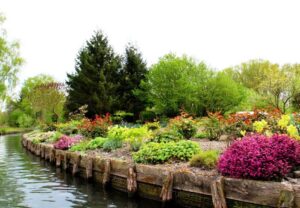
From May to September, the Hortillonnages are the setting for the International Garden Festival, where local artists place their latest creations, on the theme of sustainable development and environmental conservation, in the heart of the gardens, creating an interesting and original look at the environment, history and future of these floating gardens.

Amiens is also the starting point for what is known as the “Circuit du Souvenir” (Remembrance Circuit), which honours the men who fought at the Somme during WWl. It was the main town behind the front of the Battle of the Somme (1916-18), where soldiers came to be treated, rested and entertained before being sent back to the trenches. Amiens was the most important town behind the front.
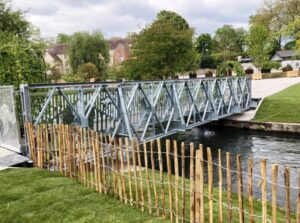
On 24 April 2024, the city inaugurated a Bailey Bridge designed to share the memory of the soldiers of the Australian Imperial Force which prevented the capture of the city during the German offensives of 1918. The memorial walkway is located near the Amiens School of Engineering, and provides access to the Amiens Botanical Gardens.
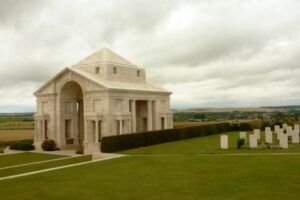
The main memorials for the wider Somme region, including Australian sites such as the Australian National Memorial at Villers-Bretonneux, 16kms east of Amiens.
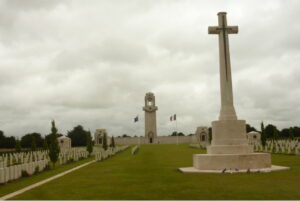
Designed by Edwin Lutyens, it commemorates over 10,000 Australians with no known grave, with views over the battlefield and links to other memorials.

The Sir John Monash Centre, also at Villers-Bretonneux, which provides context for Australian involvement in the Western Front.

The Thiepval Memorial, also designed by Lutyens, a vast memorial to the missing of the Somme, located near the Somme battlefields.
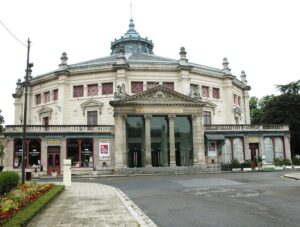
A day visit is hardly long enough for a visit to Amiens.
There is such a lot to see and do, not just in the delightful, and very rewarding town of Amiens, but further afield.
Leave a Reply