

OUARZAZATE, MOROCCO’S GATEWAY TO THE SAHARA, AND THE RED CITY OF MARRAKECH
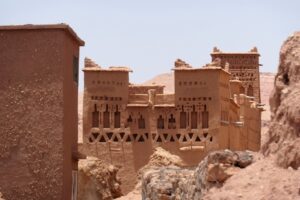
After we left Essaouria, we headed east into the interior of Morocco, to the small city of Ouarzazate, on the edge of the desert. The route is dotted with small, historic villages and farmhouses, and although it was a long trip, it was well worthwhile. The main claim to fame for Ouarzazate is that it is the location of Morocco’s Atlas film studios, and many famous films by the world’s greatest directors, were made here. While there, we also visited one of the best-known World Heritage Sites in the country, Ait Ben Haddou, a stunning fortified village made of red mud bricks, that has also featured in numerous movies. Having explored the area, we headed up to Marrakesh, our final destination in Morocco, the only place in the country we had visited on a previous trip.
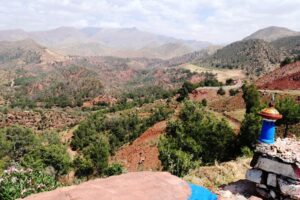
Ouarzazate, known as the “Door of the Desert”, is situated on the Saharan side of the High Atlas Mountains, nestled in the valley of the Ouarzazate River, near its confluence with the Drâa River. The city serves as a gateway to southern oases, the Drâa Valley, and the Sahara Desert, making it a strategic hub for both history and travel.
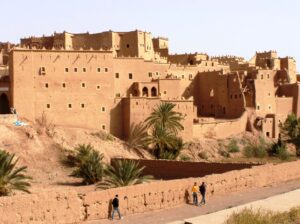
Ouarzazate was once just a small crossing point for African traders on their way to northern Morocco and then to Europe. In the 16th century, the emir of the qasba of Ouarzazate helped establish Saadi control of the region. It was home to a thriving Jewish community, but by 1954, only about 170 Jews lived in the Melleh. The “Old Synagogue”—said to be nearly 300 years old, is still in Ouarzazate.
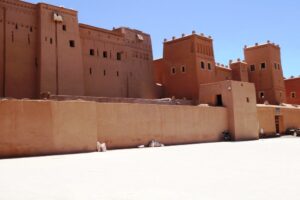
During the French period, Ouarzazate expanded considerably as a garrison town, administrative centre and customs post. The Église Saint Therese was built in 1931. The town is home to the Kasbah Taourirt, which was the kasbah of the former caïd (leader), and later owned by the Pasha of Marrakech until 1956. The city was also part of the route of the 2006 and 2007 Dakar Rally.
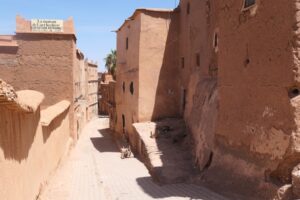
The Kasbah Taourirt, on the outskirts of Ouarzazate is the city’s historic kasbah, dating from the 19th century. Built mainly of pisé (rammed earth), it’s one of the most impressive examples of this type of structure, which characterises the architecture of the predominantly Berber-inhabited Atlas Mountain and oasis regions of Morocco. This colossal edifice shelters a true labyrinth of halls and stairways as well as sumptous rooms, communal areas such as courtyards and kitchens, as well as servants’ quarters and fortified towers that offer good views over the surrounding palm groves and the city. Note though that only about 30% of the Kasbah is open to the public, and that there is a small entrance fee of 25 Dirhams (2.50 Euros). Venture through the maze of shaded alleyways and enjoy the peaceful atmosphere. You might also find some good deals on local crafts in backstreet shops.
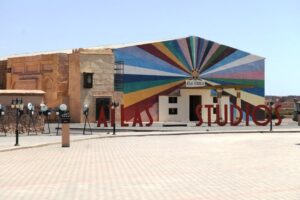
Today, Ouarzazate’s main claim to fame is that it has been the centre of the Moroccan film industry since the days of it being a French protectorate. The Atlas Studios complex on the edge of town is one of the world’s largest movie studios, and as it was open to the public, we went along. It turned out to be fascinating, with real-life outdoor and indoor movie sets, and lots of props and costumes to see.
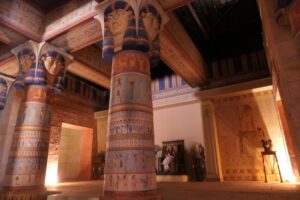
It was a delight to suddenly walk into a warehouse space and be instantly transported to the Court of Cleopatra, a scene of gladiatorial combat or a chariot being prepared for Ben Hur!
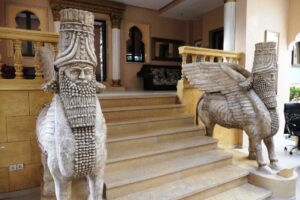
Even the lovely Riad we stayed in, Le Temple des Arts, had an interior with film-themed décor and interesting objects from film sets beautifully displayed throughout.
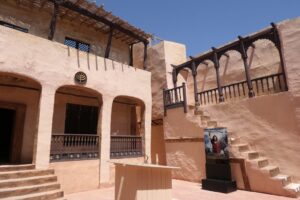
As this is very much a working studio, it’s only possible to visit via a tour. The guide was excellent, and explained about film tricks and the actual business of making movies. He also explained the real threat to the industry is that of AI, increasingly being used by studios to cut costs.
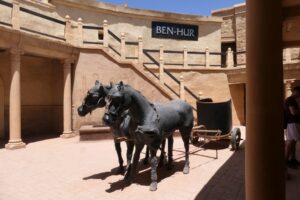
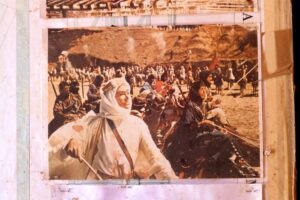
The number of internationally famous films that have been made at Atlas is incredible. As well as those mentioned, think Lawrence of Arabia, Gladiator, The Passion of the Christ, The Mummy, Kundun (which required the construction of a full-scale Tibetan monastery in the desert), Jewel of the Nile, Black Hawk Down, a number of episodes of the TV series Game of Thrones, and many, many more.
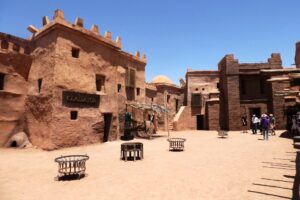
In the early 2000s, the genre of America’s “war on terrorism” could have been set in places like Afghanistan or Iraq, where filming would be near impossible. Morocco, and in particular, the Atlas Studios, has proved to be a convenient and convincing stand-in.
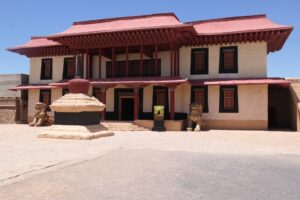
Once we had been given an introductory site tour, we had reasonable freedom to wander around to explore the site at our own pace. A really interesting experience, which we’d recommend if you’re staying in Ouarzazate.
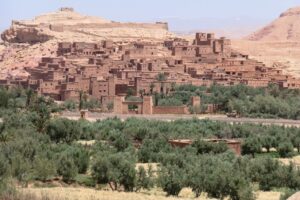
We headed off one day to visit a site very much on our Must See list. This is the fortified village (ksar) of Aït Ben Haddou, located about 30 kms north west out of Ouarzazate, in the direction of Marrakech. It sat on a major trading route between the Sahara Desert and Marrakesh. Caravans traded gold, salt and spices here. It is considered a great example of Moroccan earthen clay architecture, and has been a UNESCO World Heritage Site since 1987.
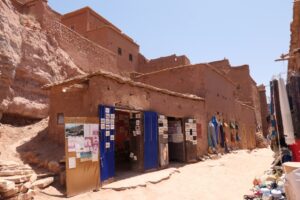
The site of the ksar has been fortified since the 11th century during the Almoravid period. None of the current buildings are believed to date from before the 17th century, but they were likely built with the same construction methods and designs as had been used for centuries. The village was one of the few routes across the Atlas Mountains, crossing between Marrakech and the Drâa Valley, on the edge of the Sahara.
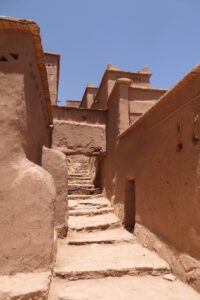
Today, the ksar itself is only sparsely inhabitied by several families, and most locals now live in more modern dwellings in the villge on the other side of the river, and make a living off agriculture, and especially off the tourist trade. In 2011 a new pedestrian bridge was completed linking the old ksar with the modern village, in order to make the ksar more accessible and to potentially encourage inhabitants to move back into its historic houses.
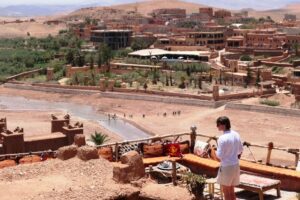
There are dwellings of various sizes ranging from modest houses to tall structures with towers. Some of them are decorated in their upper parts with geometric motifs. There are a number of public buildings, such as a mosque, a caravanserai and multiple kasbahs. There is also a public square, a Muslim cemetery and a Jewish cemetery. Outside the ksar’s walls was an area where grain was grown and threshed.
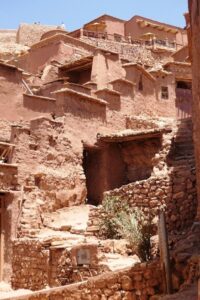
The buildings are made entirely out of rammed earth, adobe, clay bricks and some timber. These materials, being a mixture of earth an straw, are relatively permeable and easily eroded by rain over time. As a result, these types of villages can begin to crumble only a few decades after being abandoned. In the case of Aït Ben Haddou, the ksar has been significantly restored over time, thanks in part to its use as a Hollywood filming location and to its inscription on the World Heritage list. Some of the films that used the village, often as a backdrop, include Lawrence of Arabia, Oedipus Rex, Marco Polo, The Jewel of the Nile, The Man Who Would Be King, Gladiator, Queen of the Desert and dozens more.
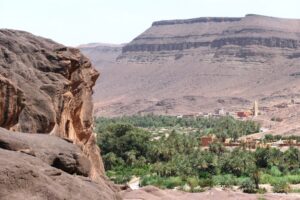
From Ouarzazate we drove north west up to Marrakech, a distance of about 193 kms. This is a spectacular route, via the high mountain viewpoint of Tizi n’Tichka, and was constructed along the old caravan trail by the French military in 1936. At the top of the pass, at an elevation of 2,260m, there is a place to stop awhile and take in the spectacular, sweepng views of the High Atlas mountains and winding roads. Fortunately, the quality of the roads makes the dramatic journey reassurring, but be aware that from November to March, snow can fall on the pass, but it can be warm all year round in the strong sun. This is the highest major mountain pass in North Africa.
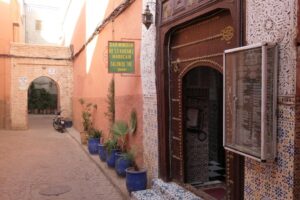
By the time we were within a short distance of Marrakech, the road had flattened out, so as we approached, we could certainly spot the “Red City”. This is the fourth-largest city in Morocco, and one of the four imperial cities of the country. It is the capital of the Marrakech-Safi region, and lies west of the foothills of the Atlas Mountains. We dropped our hire car at the airport and headed into town for the Riad that we had booked well in advance.
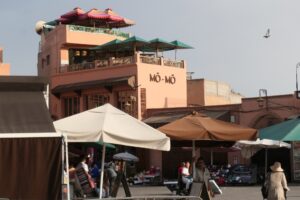
The city was founded around 1070 by Abu Bakr ibn Umar as the capital of the Almoravid dynasty. They established the first major structures in the city and shaped its layout for centuries to come. The red walls of the city were built in 1122-23 and various buildings were constructed in red sandstone afterwards, hence its nickname of the “Red City.” It became a cultural, religious and trading centre for the Maghreb. It suffered a decline for some hundreds of years, but regained its status in the early 16th century, with sultans from the Saadian dynasty embellishing the city with an array of sumptuous monuments. It became a pilgrimage site, as seven Sufi saints were buried here.
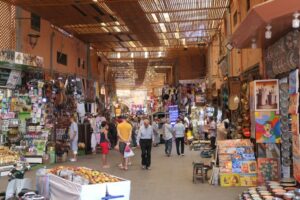
In 1912, the French Protectorate installed a Pasha of Marrakech, and this position was held until the independence of Morocco and the restablishment of the monarchy in 1956. Today, Marrakech comprises an old fortified city packed with vendors and stalls selling a huge array of merchandise, ranging from practical foodstuffs for the locals and plenty of souvenirs aimed clearly at the tourist market.
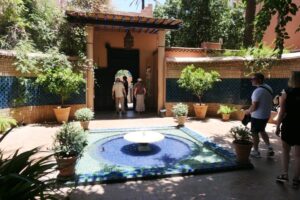
The city remains popular with the French, and a number of French celebrities own property in and around the city. One of the most famous residents was the great French fashion designer, Yves St Laurent, and his business manager and partner, Pierre Bergé. Their former villa, and the garden that they restored from a total wreck, is Le Jardin Marjorelle on the edge of town. The garden was first established in 1923 by Jacques Majorele, where he lived until the 1950s. When he died, the garden was left to decline into an almost derelict state. YSL and Bergé bought it in 1980, to save it from a real estate development project that planned to tear down the villa, trash the garden and build hotels.
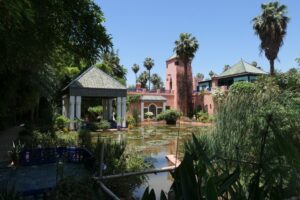
YSL was born and grew up in Algeria, so he had an afinity with North African countries and their cultures. This became their second home, and they owned it until 2008, the year YSL died—his ashes were scattered in the Majorelle Garden.
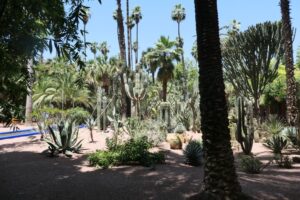
The gardens and buildings form a complex where specific buildings are dedicated to various museums and exhibits. The gardens cover over 10,000 sq.m. and are open to the public every day, and has an important collection of cacti and other plants suitable for hot, dry climates. There are a number of fountains and sculptures placed throughout the gardens and also hosts more than 15 bird species that are endemic to North Africa. The former studio workshop on the site now houses a collection of North African textiles as well as ceramics and jewellery from YSL’s and Bergé’s personal collection. The villa itself is home to the Musée Pierre Bergé des Arts Berberes (Berber Museum), as well as a collection of Majorelle’s paintings.
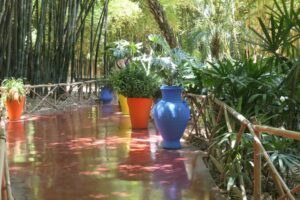
One of the most memorable aspects of a visit to the Majorelle is the use of the most beautiful, vibrant blue, used for garden pots, furniture and other features. It’s appropriately known as “Majorelle blue”. It goes without saying that there is a nice café and an excellent gift shop!
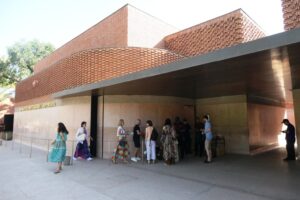
Just outside the garden itself is the Yves Saint Laurent Museum, in a side street leading to the main street, from where you can catch a taxi back into town.
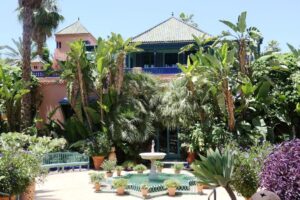
Le Jardin Majorelle is a wonderful place to visit, and it was one of the main reasons why we were happy to re-visit Marrakesh. At least a couple of hours are needed to explore it.
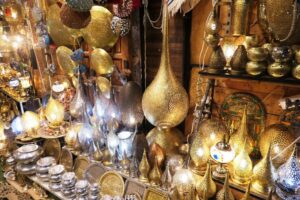
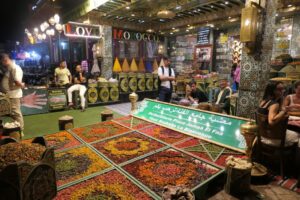
Back in Marrakech itself, it’s a maze of narrow, cobblestoned alleyways, overflowing with trinkets and treasures from local handicafts, artworks, herbs and spices, a huge amount of dubious designer knock-offs, bags, soft furnishings including the inevitable rugs, cushions, wall hangings, lamps, and anything in between. One of my favourite things to buy is Moroccan Argan oil products.
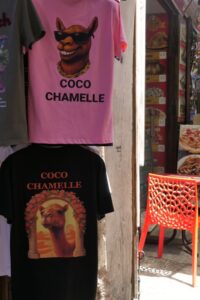 Haggling is the norm in the souks, so don’t be put off by the first price offered. It’s part of the game of a sales transaction, and is absolutely expected by the vendor. One strategy is to walk away, the seller will likely call you back to make an even lower offer, and you will sense when he has reached his lowest limit.
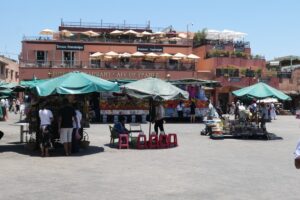
Eating is very easy in Marrakech, as one would expect. Having said that, lunch was often easier to find, as many people often make this the main meal of the day.
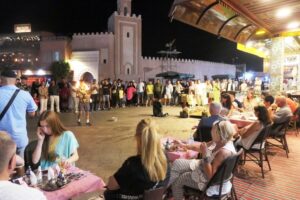
However, around the main centre of town, the Jemaa El-Fnaa Square, there are many small cafes. This Square is at its liveliest at night, when you will see acrobats tumbling and fire-eaters flinging flaming torches high in the air before supposedly eating the flame.
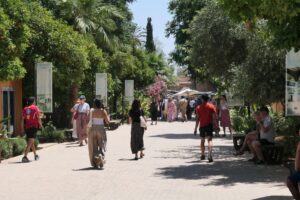
Check out Rahba Kemima Square, the El Badi Palace just off Jemaa el-Fnaa, with its sunken gardens and pool, and the Bahia Palace, that has over 150 rooms that lead to patios and gardens, and the harem. However, be aware that the rooms are empty of furnishings and decoration.
Marrakech is easy to get to. There’s a busy international airport 6 kms out of town—Paris is just over 3 hrs to either CDG or Orly; a bus station that includes long-distance buses, and a railway station that connects the city directly to many destinations across Morocco.
WOW OMG… nothing prepares you for your pictures and desciption of these towns and historic sites
Yes, it is certainly very atmospheric and picturesque. The landscape has so much to do with the attractions of this fascinating country. I can understand why people are drawn back so many times.